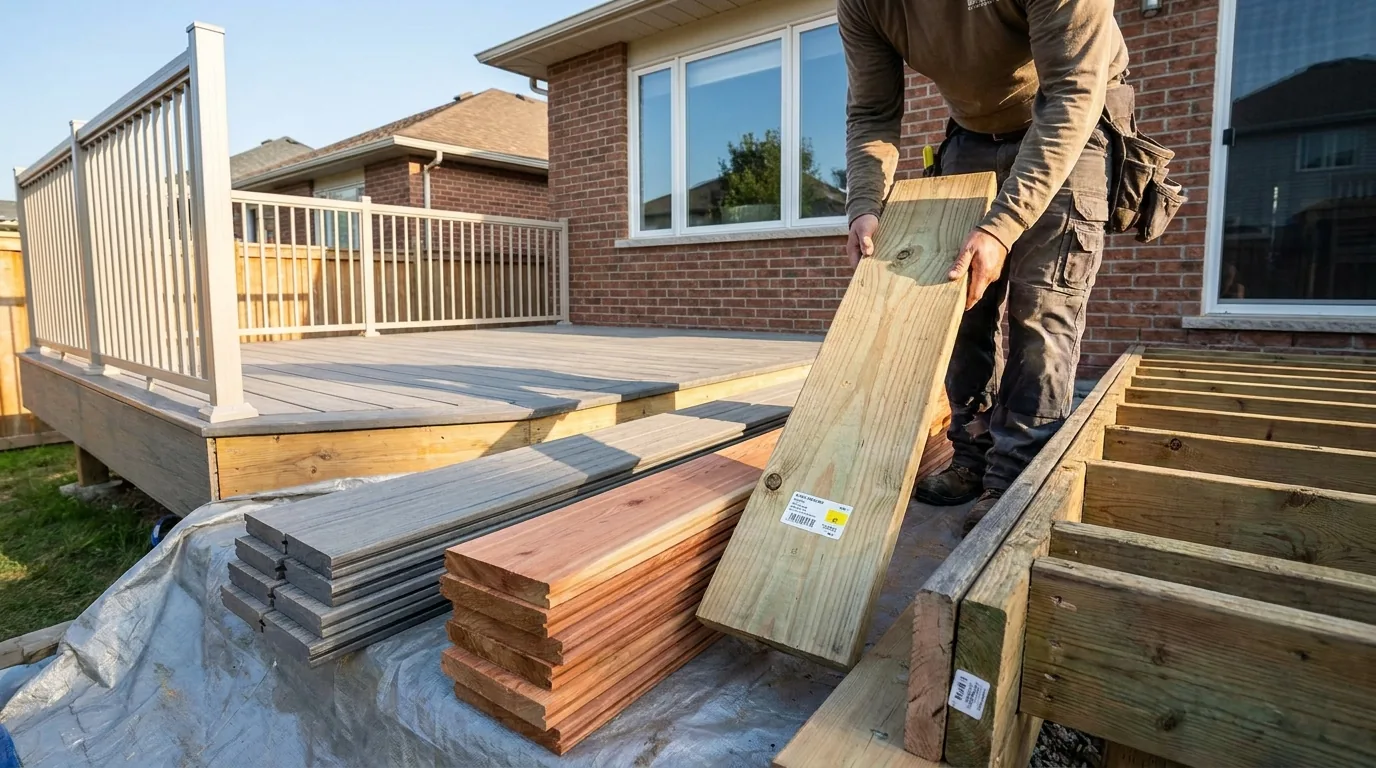
A homeowner in Orleans called me last spring asking why his neighbour's deck quote and ours could possibly be for the same thing when ours was so much higher. They weren't the same. Same square footage, same height. Different footings, different framing spec, different fasteners, different boards, different expected lifespan by 15 years.
Most deck quotes in Ottawa look comparable on the first page. They are not. Below is what drives the installed cost of each board material, what flips the number underneath, and where the City of Ottawa permit threshold catches people off guard.
Pressure-treated: the budget baseline
The default. Pressure-treated southern yellow pine has been the Ottawa deck material for 30 years for one reason: it is the most economical material and it works. Treated to UC4A or UC4B for ground contact, fastened to PT joists, on PT or steel posts to footings below frost.
At the base spec you get: 5/4 PT board, 16-inch joist spacing, 2x10 PT joists, sonotube footings, basic 36-inch PT railing, and stairs to grade. This is the most budget-conscious way to build a 12 by 16 deck (192 sq ft) that lasts, plus the City permit if you cross the threshold.
What pushes a PT deck up the range: 12-inch joist spacing for a stiffer feel underfoot, hidden fasteners (rare in PT but possible), aluminum spindle railings instead of PT pickets, and helical screw piles instead of sonotubes. Same square footage, higher spec, higher total.
How long PT actually lasts in Ottawa
Properly installed and re-stained every 2 to 3 years, PT decking lasts 15 to 22 years. The framing under it (also PT) lasts 25 to 35. Most failures we tear out are not the boards; they are the ledger flashing detail that wasn't done right and rotted the rim joist on the house.
Cedar: the mid-tier upgrade
Western red cedar is the upgrade most Ottawa homeowners think they want. It looks better than PT for the first 5 years. After that, both turn grey unless you stain. The real reason to choose cedar is feel: softer underfoot, cooler in summer sun, no chemical leach.
At the base cedar spec you get: 5/4 cedar deck boards, PT framing underneath (cedar joists are not standard practice in Ottawa; they don't last in our wet shoulder seasons), stainless or coated screws, cedar railing, and standard footings.
What pushes a cedar deck up the range: clear-grade cedar instead of knotty, hidden fasteners with a rip-and-groove edge profile, premium oil finish on installation, glass-panel railings, and built-in features like benches or planters.
The cedar trap: warranty
Cedar comes with no real warranty. The mill warranty covers manufacturing defects only, not weathering, splitting, cupping, or checking, all of which happen normally. Composite carries 25 to 50-year manufacturer warranties. PT carries 25-year limited warranties on the lumber itself. Cedar's beauty is real; its longevity guarantee isn't.
Composite: the premium, low-maintenance tier
Composite is the category that is actually worth paying for if you plan to stay 12-plus years. Trex, TimberTech, Fiberon, MoistureShield. Capped polymer-wrapped boards, no staining ever, 25 to 50-year fade and stain warranties, no splinters.
At the entry composite spec you get: entry-level composite (Trex Enhance Basics or equivalent), PT framing 16-inch on centre, hidden fasteners, basic composite railing, sonotubes.
What pushes a composite deck to the top of the range: premium capped composite (Trex Transcend, TimberTech Azek), 12-inch joist spacing, helical piles, glass-panel or cable railings, aluminum framing instead of PT, and integrated lighting in the railing posts.
Composite cost-driver breakdown
These are the line items that make up a composite deck, ordered roughly from the largest budget drivers down. The board material is only one of them, and rarely the biggest:
- Labour (tear-out if applicable, install, finishing): typically the single largest line on the job.
- Footings (helical piles or sonotubes): a major driver, and helicals add to it.
- Composite decking material: varies widely by product line.
- Composite or aluminum railing: glass-panel or cable upgrades push this higher.
- PT framing (joists, beams, ledger, blocking): scales with deck size and joist spacing.
- Stairs and stringers: driven by deck height and number of runs.
- Permit fee plus drawings: the City fee plus any engineered drawings.
- Hidden fasteners: a smaller but real add over face-screwing.
What flips the price under the boards
Three things move a deck quote that aren't visible after the project is done. They matter more than the board material for long-term cost.
Footing type. Helical screw piles cost more per footing than sonotubes, and a 192 sq ft deck typically needs 6 to 9 footings, so the choice is a meaningful line item just for the holes in the ground. Helicals are mandatory in some clay-heavy Ottawa neighbourhoods (Barrhaven, parts of Orleans, Findlay Creek) because sonotubes heave.
Joist spacing. 16 inches on centre is code minimum for most decking. 12 inches on centre is required for some composite lines and recommended for any board that will see heavy patio furniture or hot tubs. Going from 16 to 12 inches adds framing material and labour across the whole deck.
Ledger detail. The ledger board is how the deck connects to your house. A bad ledger detail rots your rim joist and lets water into the basement wall. A proper ledger has metal flashing, a 1/2-inch standoff for drainage, lag bolts or structural screws on a defined pattern, and a re-flash where it meets the house siding. Doing it right is a real line item, and the cheapest quotes are usually the ones that skip half of it.
The framing and footings outlast the boards. Spend money there first. Anyone can swap board material in 20 years; nobody re-frames a deck.
The Ottawa permit threshold
Ottawa requires a permit for any deck taller than 24 inches above grade or attached to the house. Free-standing patio at grade: no permit needed. Anything else: permit. The City of Ottawa permit minimum is $117, and the fee scales up with deck size and complexity from there.
The catch: a permit means an inspector verifies your footings, joists, ledger, and railings. About 60 percent of unpermitted decks I tear out have at least one major defect: under-sized joists, unflashed ledger, or footings above frost line. The permit isn't just a fee; it's a quality check. Skipping it usually costs more than paying it.
Real example: Westboro 2025
14 by 18 raised deck (252 sq ft), 38 inches above grade. TimberTech Azek decking, aluminum railing with glass panels, 8 helical piles, 12-inch joist spacing, integrated post-cap lighting. Priced as a fixed written proposal. The only change was a ledger upgrade to a Simpson ledger lock pattern after we found the existing rim joist had been sistered in a previous reno, added as a transparent line item the homeowner approved before we proceeded. Permit issued in 11 days.
Which one to pick
The honest decision tree.
- Plan to sell within 6 years: pressure-treated. The buyer doesn't pay you back for composite.
- Plan to stay 8-plus years and want zero maintenance: composite. Premium tier.
- Want a deck that looks beautiful and you don't mind staining: cedar.
- Have kids and pets and want forgiveness on spills, salt, claws: composite, capped, premium tier.
- Working with a tight project budget: pressure-treated, properly built. Don't try to stretch into composite by skipping joist spacing or fasteners.
Where Ottawa neighborhoods change the math
Glebe and Centretown row-house decks: tight access often means hand-carrying material 60-plus feet from the street, which adds trip labour as its own line item. Helical piles aren't always practical because of access; sonotubes plus extra concrete is often the call.
Kanata, Stittsville, Findlay Creek post-2005 builds: clay soil. Helicals are worth the upgrade. We've torn out enough heaved sonotube decks in those neighborhoods to make this a default recommendation.
Manotick, Carp, rural lots: easy access, no setback issues. Composite makes the most sense because you're staying long-term and the resale market here pays for the upgrade.
For permit details and the City of Ottawa thresholds, our Ottawa permits page walks through the application process. The bottom line on decks: spend on framing and footings, save on board material if you must. A well-built PT deck outlasts a poorly-built composite one. Call 613-862-4555 for a fixed written proposal on yours.