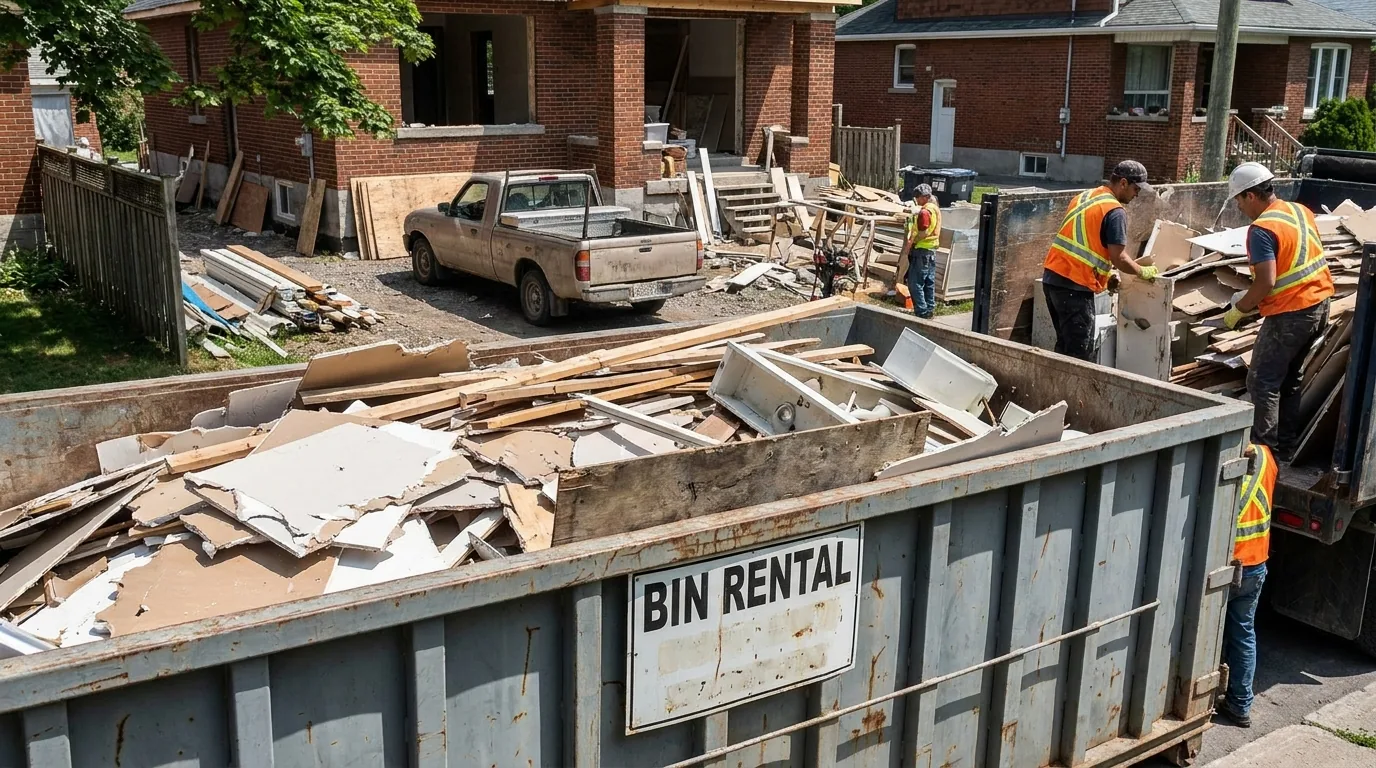
A Sandy Hill homeowner brought us a competing quote last summer that listed "demolition and disposal" as a single low line. The job was a full-gut kitchen with knob-and-tube wiring on the demo list, plaster walls, and a built-in china cabinet that had to come out in one piece.
The real demo and disposal scope was several times what that line allowed for.
Demolition is the single most under-quoted line item in Ottawa renovations. Three things drive it up that homeowners and rookie estimators routinely miss: bin tipping fees, hazardous material handling, and protection labour. Below is what actually drives those costs and where budgets come in too low.
The bin and the tipping fee
Most Ottawa renovations need at least one disposal bin. Bin sizes are measured in cubic yards, and the right size depends on the demo scope:
- 10-yard bin: holds about 3 tons of construction waste. Suits a bathroom gut.
- 14-yard bin: 4 to 5 tons capacity. Good for a kitchen or small basement.
- 20-yard bin: 6 to 7 tons. Standard for full kitchen plus living room demo.
- 30-yard bin: 9 to 10 tons. For full-home or addition demo.
- 40-yard bin: 12+ tons. Demolition of full additions or large basement gut-outs.
The base rental gets you the bin on-site for a set window and disposal of the first allotted weight (typically 1 ton on a 10-yard bin, 2 tons on a 20-yard, 4 tons on a 30-yard). Past that, you pay per-ton tipping fees at Trail Road or private transfer stations.
The trap: a cheap-looking bin rental quote covers only the base allotment. Weigh out heavier than the allowance and the overweight tipping fee can rival the rental itself. The number that matters is the total once expected tonnage is priced, not the base rental headline.
Drywall, plaster, and tile weight
The reason demo bins go over weight is that drywall and tile are heavier than they look. Some 2026 reference numbers:
- Drywall: 1.6 to 2.0 lb per square foot. A typical bathroom gut produces 800 to 1,200 lb of drywall waste.
- Plaster on lath (pre-1950 homes): 7 to 9 lb per square foot. Five times the weight of drywall. A Glebe kitchen demo can produce 4,000 to 6,000 lb of plaster.
- Ceramic tile: 4.5 lb per square foot. Bathroom floor and walls combined: 600 to 900 lb.
- Concrete (basement slab cuts): 150 lb per cubic foot. A 24-inch by 12-foot drain trench produces about 600 lb of concrete chunks.
- Cast-iron plumbing: 6 to 9 lb per linear foot. Old waste stacks weigh more than the framing.
The cost differential between a Hintonburg 1925 plaster home and a Barrhaven 2008 drywall home for identical-looking demo scopes is real. The same kitchen demo can cost more than double at the older address, purely on disposal weight and handling.
The Trail Road weight scale
Ottawa's main municipal disposal site is Trail Road Landfill on Moodie Drive. Construction waste is charged per metric ton with a small minimum. Mixed loads pay the highest rate; sorted loads (clean wood, clean concrete, clean drywall) pay less, which is why sorting on site lowers disposal cost.
Most contractor bin companies haul to Trail Road or to private transfer stations like GFL or Tomlinson, which bill per ton plus haulage. Get a tonnage estimate from your contractor up front.
Asbestos: the budget-killer
Any Ottawa home built before 1990 may contain asbestos. Common locations: vermiculite attic insulation (Zonolite brand), drywall joint compound (1965-1980), 9x9 vinyl floor tiles (1950-1980), pipe insulation wrap, popcorn ceiling textures, and exterior siding shakes.
If asbestos is suspected, the law requires a Type 1, 2, or 3 abatement procedure depending on the disturbance scope. Costs in Ottawa as of 2026:
What drives the abatement line, from lightest to heaviest:
- Asbestos sample testing: lab-confirmed in 3 to 7 days. The least expensive step and the one that prevents the expensive surprises.
- Type 1 abatement (small disturbance, no friable material): a modest supplement to the demo line.
- Type 2 abatement (moderate disturbance, one room, controlled): meaningfully more, because containment and controlled removal are required.
- Type 3 abatement (large disturbance, friable material, full enclosure): the costliest tier, driven by full enclosure, negative-air systems, and certified disposal.
- Vermiculite attic removal (Type 3 by default): priced by attic square footage and access difficulty.
This is why every honest Ottawa renovation contract on a pre-1990 home includes an asbestos contingency line, and why we test before we demo on suspicious materials. The cost of testing is trivial; the cost of an emergency abatement after exposure is significant.
Lead paint and other regulated materials
Lead paint (banned for residential use in Canada in 1976) shows up in homes built before that date. It is not as expensive to handle as asbestos but does require dust-control protocols. Expect added labour and PPE for any pre-1976 sanding or paint disturbance.
Mercury thermostats, fluorescent tubes, smoke detectors, fridges and freezers all carry separate disposal rules. Each one is a specialty drop-off fee plus haulage. A kitchen demo with one fridge, two thermostats, three fluorescent fixtures, and one smoke detector adds special-handling charges that don't go in the bin and rarely show up on a thin quote.
Protection labour
This one homeowners almost never see in a quote and pros never skip. Before demolition starts, the rest of the house has to be protected from dust, debris, and tracked-in mud.
Standard protection package on a kitchen demo:
- Floor protection (Ram Board or 1/4-inch hardboard) installed and removed across the hallway and living-room run.
- Plastic dust walls with zipper doors at room boundaries.
- HEPA air scrubber rental (recommended for any plaster or asbestos work).
- Furniture wrap, art removal, and relocation of sensitive electronics.
Protection labour scales with the size of the area being shielded, the run of flooring to cover, and how many rooms need dust walls. Our quotes line-item this; many cheap quotes hide it or skip it entirely, then the homeowner pays for it later when their hardwood gets scratched.
The "demo by owner" myth
Some homeowners offer to handle their own demo to save money. The labour savings on a properly-quoted job are modest. The risks are higher.
What goes wrong:
- Cutting active plumbing or electrical lines (a real call we got from a Kanata client at 8pm on a Sunday).
- Damaging walls or floors that were not meant to be removed.
- Pulling vapour barrier or insulation that must be reinstalled.
- Discovering asbestos and continuing anyway because the project is already started.
- Not removing structural elements correctly, requiring redo when the contractor arrives.
Honest answer: DIY demo on a powder room or a single closet is fine. DIY demo on a kitchen, bathroom, or basement, in any home built before 1990, is rarely worth the saved labour.
The cheapest demo quote is almost always the one that left the most off the page. Read the line items, not the total.
What to ask your contractor
Five questions that surface real demo-and-disposal costs before you sign:
- What size bin does this project need, and how many trips?
- Is the tipping fee included at the actual expected tonnage, or based on the base allotment?
- Has the home been built before 1990? If yes, has asbestos sampling been done or budgeted?
- What protection package is in the quote (floor protection, dust walls, air scrubbers)?
- What is the contingency for hidden hazards, and how is it handled in the contract?
Real Ottawa example: Findlay Creek 2025
Full kitchen and powder-room renovation, 2009 home. The demo came in about 11 percent over the quoted line because one cabinet had been adhered to the drywall with construction adhesive instead of screws and the drywall came off in chunks. Within contingency, no change order needed.
Compare to a Glebe 1922 home, kitchen renovation, same scope on paper. The demo ran roughly 10 percent over once we encountered Zonolite vermiculite in the soffit cavity that needed Type 3 handling, all documented in the asbestos contingency clause. In absolute terms the older home's demo cost was multiples of the newer one's.
Same scope, very different demo numbers. The age of the house is the variable nobody reads.
Honest demo and disposal numbers come from honest scoping. Call us at 613-862-4555 for a fixed-price quote that line-items demo, disposal, asbestos contingency, and protection labour separately. No surprises mid-job.
Frequently asked questions
What size disposal bin does a renovation need?
The right disposal bin size depends on demolition scope. A 10-yard bin holds about 3 tons and suits a bathroom gut. A 14-yard bin holds 4 to 5 tons, enough for a kitchen or small basement.
A 20-yard bin takes 6 to 7 tons for a kitchen plus living room demo, a 30-yard bin 9 to 10 tons for full-home or addition demo, and a 40-yard bin 12 tons or more.
Why do renovation disposal bins go over the weight allowance?
Disposal bins go over weight because drywall, plaster and tile are heavier than they look. Drywall weighs 1.6 to 2.0 lb per square foot, while plaster on lath in pre-1950 homes weighs 7 to 9 lb, about five times as much.
A Glebe kitchen demo can produce 4,000 to 6,000 lb of plaster. Ceramic tile runs 4.5 lb per square foot, and cast-iron plumbing 6 to 9 lb per linear foot.
Which materials in older Ottawa homes may contain asbestos?
Any Ottawa home built before 1990 may contain asbestos. Common locations are vermiculite attic insulation (Zonolite brand), drywall joint compound from 1965 to 1980, 9x9 vinyl floor tiles from 1950 to 1980, pipe insulation wrap, popcorn ceiling textures and exterior siding shakes. Lab testing confirms samples in 3 to 7 days, and a suspected find requires a Type 1, 2 or 3 abatement procedure depending on the disturbance.
Is it worth doing your own demolition to save money?
DIY demolition is fine on a powder room or a single closet, but on a kitchen, bathroom or basement in any home built before 1990 it is rarely worth the labour saved. Common problems include cutting active plumbing or electrical lines, damaging walls or floors meant to stay, pulling vapour barrier or insulation that must be reinstalled, and carrying on after discovering asbestos.
What should I ask a contractor about demolition and disposal?
Five questions surface the real demolition and disposal scope before signing. Ask what size bin the project needs and how many trips. Ask whether the tipping fee is included at the expected tonnage or only the base allotment. Ask whether asbestos sampling has been done or budgeted on a pre-1990 home. Ask what protection package is included, and what contingency covers hidden hazards.
Official references
- Keeping the Heat In, Natural Resources Canada