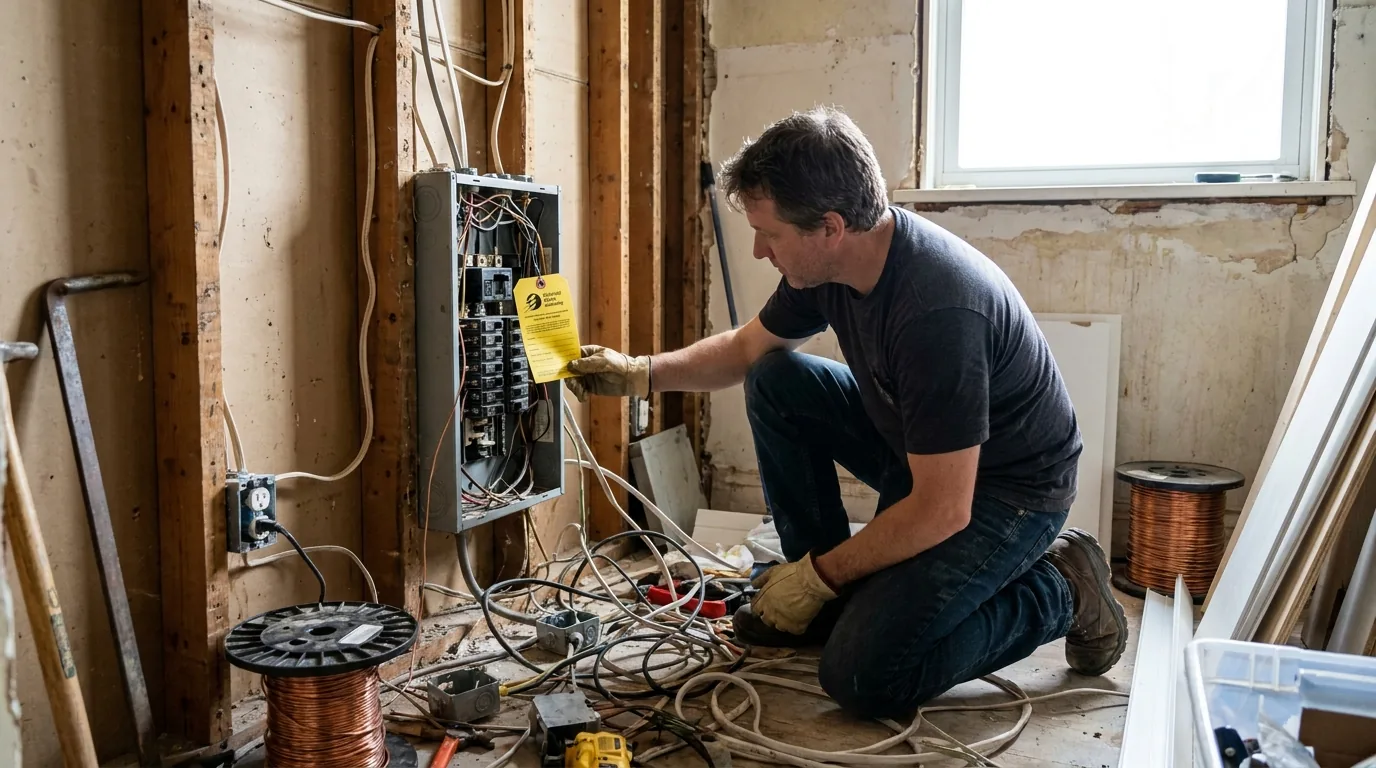
People ask me this every week. Can I do my own electrical work in Ontario? Short answer: sometimes. The longer answer is the part that keeps people out of trouble with the Electrical Safety Authority and out of trouble with their insurance company.
Ontario electrical rules are run by the ESA, the Electrical Safety Authority. They enforce the Ontario Electrical Safety Code (OESC). The OESC is the rulebook. The ESA is the cop. Every piece of electrical work in this province falls under one or the other.
What you can legally do as a homeowner
If you own and live in the home, you can do your own electrical work. Yes, even rough-in work, even panel work, even a sub-panel in a basement.
The catch is the words "you can do." That does not mean "without the ESA." Every job above a certain size needs a notification of work filed with ESA, and an inspector comes to look at it before you close up the walls and again at the end.
The work that requires an ESA notification (which costs about $90 to $200 for a residential job depending on scope):
- Adding a new circuit
- Replacing or upgrading the electrical panel
- Installing a sub-panel
- Any rough-in for a renovation (basement, kitchen, bathroom, addition)
- Hot tub, pool, EV charger, solar tie-in
- Service upgrade (100A to 200A)
The work that does not need a notification:
- Replacing a light fixture with another of similar wattage
- Replacing a switch or receptacle with the same type
- Replacing a damaged plug or cord on an appliance
That is the entire list of work you can do without telling the ESA. Everything else needs a notification, even if you are doing the work yourself.
What is actually illegal
The line gets crossed in three places. These are the ones that have real legal consequences in Ontario.
Doing electrical work for hire without a licence
If you are doing electrical work for somebody else and getting paid, you must be a Licensed Electrical Contractor (LEC). It does not matter if it is your brother, your neighbour, or a homeowner you met on Kijiji. If money or trade is changing hands, you need an LEC. The Electricity Act and the OESC are clear on this. Penalty is fines that start at $1,000 and reach $50,000 for individuals, plus the work has to be torn out and redone by a licensed contractor.
Doing electrical work in a rental unit
If the home is a rental, the homeowner cannot do their own electrical work even if they own the building. Once a property has tenants, all electrical work must be performed by a Licensed Electrical Contractor. This catches a lot of small landlords in Ottawa, especially the ones who finished a basement themselves and then started renting it out.
Doing electrical work in a commercial building
Even if you own the storefront or the office condo, you cannot do your own electrical work in a commercial space. Commercial electrical is LEC-only territory in Ontario.
The "I'll just do it without a permit" trap
Most homeowners who do illegal electrical do not get caught at the time. They get caught later. The two trigger events: a fire (the insurance investigator finds unpermitted wiring), or selling the house (the buyer's home inspector flags non-standard work and the lawyer asks for ESA documentation). At that point the only option is to pay an LEC to inspect, correct, and certify the work, which costs many multiples of what doing it right would have cost.
Why your insurance walks away on unpermitted electrical
This is the part that does not get talked about enough. Home insurance policies in Ontario have a clause that excludes coverage for losses caused by work that was not done in compliance with applicable codes and laws.
If you have an electrical fire and the investigator finds a circuit that was added without an ESA notification, the insurer's position is straightforward. The work was not legal. The loss is not covered. The fire damage to your home, to your contents, and any liability if a tenant or neighbour was injured, is on you personally.
I have seen this play out twice in Ottawa with my own clients. Once it was a basement panel a previous owner had wired in 1998 without notification. The new owner had a fire 25 years later. Insurance paid for the fire damage but not for the electrical re-wire of the rest of the house, which they argued was pre-existing non-compliance. The homeowner was left covering the entire re-wire out of pocket.
The second one was a coach house in Hintonburg. The owner ran a 60A sub-feed to it themselves with no notification. A small fire from a space heater, no major damage, but the insurance investigator found the unpermitted feed. They paid the immediate damage and then refused to renew the policy. The owner had to disclose the non-renewal to every other insurer, which sent his rates into the stratosphere.
How an ESA inspection actually works
Most homeowners avoid the ESA because they think it is a nightmare bureaucracy. It is not. The process is quick.
- Apply for a notification online at esasafe.com. Cost is $90 to $200 for a residential job. About 10 minutes of paperwork.
- Do the rough-in. Wires pulled, boxes installed, nothing covered up.
- Schedule the rough-in inspection. Inspector comes within a week, looks at the work, leaves a defect list if anything is wrong.
- Fix any defects. Close up the walls.
- Do the trim-out. Devices, fixtures, panel connections.
- Schedule the final inspection. Inspector comes back, signs off.
- You get a Certificate of Inspection. Keep it forever. It is what proves the work was legal at sale time.
The whole process for a basement renovation runs about 4 to 6 weeks of inspector time spread across the project. The inspector wants you to pass. They are not trying to fail you, they are looking for safety hazards. If you did the work to code, you pass.
The ESA notification is the cheapest insurance you will ever buy. A small fee and an inspection today saves a catastrophic uninsured loss in fifteen years.
The honest version
If you are handy, careful, and willing to read the OESC, you can do most residential electrical work in your own home. The notification is cheap. The inspector is helpful. The certificate protects your insurance and your resale.
If the work is in a rental, a commercial space, or a job you are getting paid for, hire a Licensed Electrical Contractor. There is no grey area. Every home renovation we run includes a full ESA-permitted electrical scope, and the cost shows up as a line item on the quote.
The thing nobody tells you about DIY electrical: doing the work to code is not actually that hard. Hiding the work from the ESA is the part that wrecks lives.