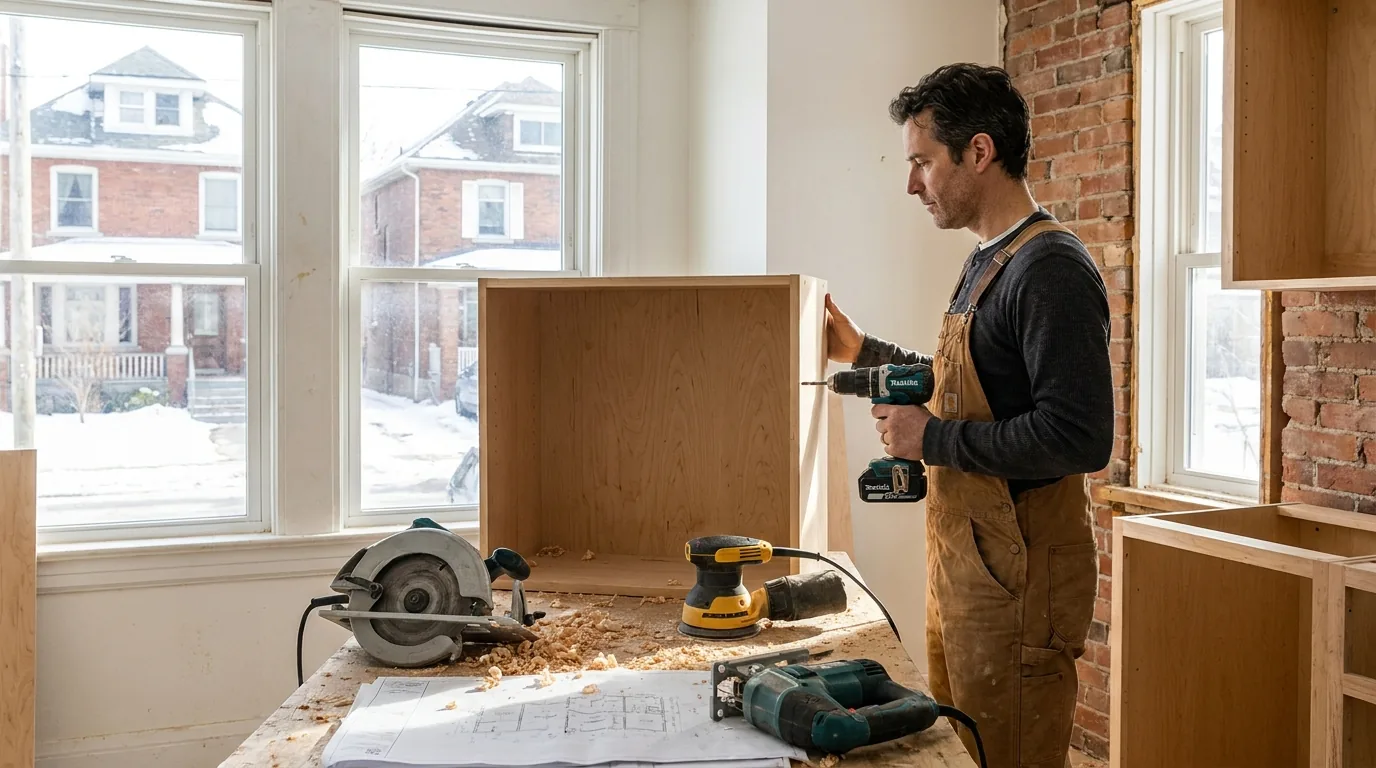
Walk into any Home Depot in Nepean on a Saturday and you'll see a homeowner with a cart full of tools they will use exactly once. The drill press goes on the basement shelf. The biscuit jointer never comes out of the box. Two years later they sell the lot at a garage sale for a quarter of what they paid.
Twenty years of Ottawa renovation work taught me which tools earn their keep in a homeowner's garage and which ones you should rent the three times you actually need them. Here is the honest list.
The five tools every Ottawa homeowner should own
If you do anything beyond hanging a picture, these five pay for themselves inside two years. Buy them once, buy them good, never buy them again.
1. An 18V or 20V cordless drill/driver kit
This is the only tool with no honest substitute. Not the impact driver, not the corded drill, not the screwdriver in a kitchen drawer. A solid brushless drill/driver in the 18V or 20V class drives screws, bores pilot holes, mixes thinset, drills into masonry with a hammer mode, and runs hole saws.
The kit you want includes the drill, two batteries (so one charges while you work), a charger, and a hard case. Buy a mid-tier brushless kit, not the bottom-shelf bundle. Brands worth the money: DeWalt 20V Max, Milwaukee M18, Makita LXT. Skip the cheap-bin drills with NiCad batteries from a decade ago. The torque is half, the runtime is a third, and the chuck eats bits.
2. A 7-1/4" circular saw
The single most useful saw a homeowner can own. It crosscuts framing lumber, rips plywood sheets, cuts laminate, trims doors, and (with the right blade) cuts cement board. With a clamp-on straight edge and an inexpensive guide rail, a mid-range circular saw does 90% of what a premium track saw does at a fraction of the outlay.
Cordless or corded? For occasional weekend use, corded is fine and cheaper. For a basement that's three rooms away from an outlet, cordless wins. Brushless 18V or 20V models cut a full sheet of 3/4" plywood on a single battery.
3. An oscillating multi-tool
The tool nobody buys first and everybody wishes they had. It cuts drywall around outlets, trims door jambs to fit new flooring, removes grout, scrapes old caulk, plunge-cuts a notch in a stud, and flush-cuts a bolt. None of those jobs has a better tool for them.
Corded models are the cheaper entry; cordless costs more for the freedom from a cord. The Fein Multimaster invented the category and is still the best, but the DeWalt and Milwaukee models cost far less and do 95% of the work.
4. A solid level set (24" and 48")
Not a power tool, but on the list because nothing else replaces it. Cabinets that aren't level look wrong. Tile that isn't level looks worse. A laser level helps with long runs but doesn't replace a real beam level on a cabinet face or a vanity.
Brands: Stabila for the long levels (German, machined, lifetime accuracy), Empire or Johnson for shorter ones. Buy the machined aluminum pair, not the bargain bin. Avoid the plastic levels at the bottom of the bin. They are out of true the day you buy them.
5. A 25-foot tape measure
The tool everyone owns and most people own wrong. A flimsy tape with a wobbly hook ends up off by 1/8" on every measurement, which compounds across a kitchen layout into a gap at the backsplash. Spend a little on a Stanley FatMax or Milwaukee Magnetic rather than the giveaway tape. The hook is rivetted, the blade is wide enough to stand out 8 feet, and the markings are legible.
Safety warning: respiratory protection is the tool you will skip
Drilling concrete, cutting MDF, sanding old paint in a pre-1990 Ottawa home, demoing tile, breaking up plaster, all of it generates dust that damages lungs in ways you don't feel for 20 years. Pre-1980 paint can contain lead. Pre-1990 drywall joint compound can contain asbestos. A P100 half-face respirator (3M 6200 series) is the cheapest insurance you'll ever buy. Wear it. The dust mask from the paint aisle is for sweeping, not demo.
The four tools worth buying if you do real projects
If you've done one or two basement projects and want to keep going, these are the next tier. Each one solves a specific problem the starter five can't.
- Compound miter saw (10" or 12"): a mid-range purchase. The only way to get accurate, repeatable angled cuts on baseboards, casing, crown moulding, and deck framing. An entry Ryobi or DeWalt sliding miter handles 95% of homeowner work. Skip the dual-bevel premium models unless you're doing crown.
- Cordless brad nailer (18 ga): a mid-range purchase. Pneumatic nailers need a compressor and hose. Cordless nailers eliminate both. For trim, casing, paneling, the difference between hand-nailing and brad-nailing is two hours per room.
- Random orbit sander: an inexpensive-to-mid purchase. Refinishing a piece of furniture, prepping a door for paint, smoothing a table you built, nothing else does it. The dust collection on the better units (Festool, Bosch GET) is worth the money if you sand inside.
- Shop vac with a HEPA bag: a mid-range purchase. Demo dust, drywall dust, sawdust, water from a backed-up drain. Connect it to the table saw or sander and the work site stays clean. The HEPA upgrade matters for old-house dust.
The six tools you should rent, not buy
These are tools that look essential, but on a typical homeowner's project schedule of one or two reno weekends a year, the rental cost is a fraction of ownership. Home Depot Tool Rental, Stevens Renta-Tool, and most independents in Ottawa carry all of these.
- Tile saw (wet): rent by the day. Use it once for a 60 sq ft bathroom, then return it. Buying a quality one ties up real money and it sits in storage rusting.
- Concrete jackhammer / SDS rotary hammer: rent by the day. Demo a basement bar, break up a slab, set anchor bolts. Total time on the job is usually under 4 hours.
- Floor sander (drum + edger): rent by the day plus paper. Refinish hardwood once. Owning one is for contractors.
- Pressure washer (gas, 3000+ PSI): rent by the day. The electric ones at Canadian Tire are too weak for serious deck stripping. Rent gas, do the deck and the driveway in one weekend, return.
- Plate compactor: rent by the day. Compacting gravel under a patio or shed pad. You'll never need it again.
- Insulation blower: often free with a bulk cellulose purchase at Home Depot. Used for one attic top-up. Don't buy.
The four tools homeowners buy and shouldn't
These get marketed hard, look impressive on a YouTube channel, and almost never pay back for a homeowner.
- Table saw (jobsite): a meaningful spend for a decent one. Useful, but a circular saw with a guide rail does most of the same cuts. If you don't have a dedicated workshop space, the table saw lives in a corner gathering dust.
- Biscuit jointer or domino: cabinetmaker tools. Homeowner alternative is pocket-hole screws (an inexpensive Kreg jig) which work for 95% of cabinet and furniture joinery a homeowner attempts.
- Welding kit: unless you've taken a class. Welding is a skill, not a tool you buy and figure out.
- Bench-top drill press: useful, but only if you're doing furniture. For drilling holes in wood and metal occasionally, a hand drill plus a guide block accomplishes the same thing.
The tool that makes a renovation faster is rarely the tool you bought. It's the tool the next-door contractor lent you because he could see you were struggling.
Brand math for Ottawa homeowners
Tool brands fall into three honest tiers for homeowner use:
Tier 1 (worth the money for tools you'll use 50+ hours): DeWalt 20V Max, Milwaukee M18, Makita LXT. Pick one battery platform and stick with it. The drill, impact driver, circular saw, and oscillating tool all share batteries. Buying across platforms is a tax on disorganization.
Tier 2 (great value for tools you'll use 5-50 hours): Ryobi 18V One+, Bosch 18V, Hercules (Harbor Freight). The Ryobi platform especially has 200+ tools on one battery, including odd ones like a portable inflator and a glue gun. For a homeowner whose tools see weekend use, Ryobi delivers most of DeWalt's capability for a good deal less.
Tier 3 (skip): anything bottom-shelf at a big-box store with no battery platform brand. The cheap starter kit is money you'll spend twice when the drill dies in year two.
The honest budget
The five-tool starter set is a moderate outlay if you buy mid-tier (Ryobi or DeWalt entry models). The next four tools add to that. Even fully equipped, a homeowner tool collection that handles 95% of typical DIY projects across an Ottawa house costs less than a single trade callout on a botched job, which is the whole point of owning the right tools.
For projects beyond that, additions, structural work, anything requiring permits, anything where bad cuts compound into expensive mistakes, the right move is to call a contractor. We handle the design, the permits, the BCIN-stamped drawings, and the warranty. For more on what that process looks like in Ottawa, see our home renovation Ottawa page.