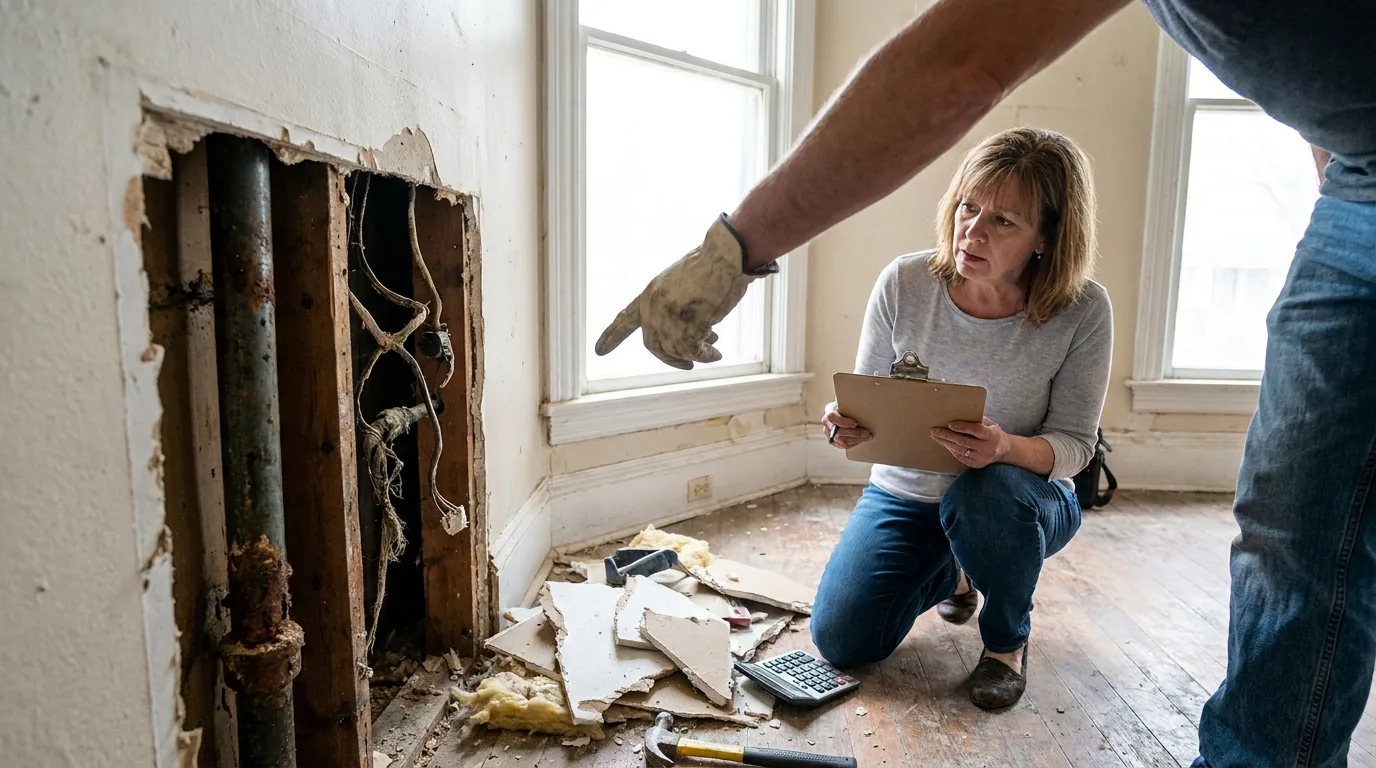
The quote says one number. The final invoice says a bigger one. The contractor isn't lying, and you're not crazy. The gap is the part of the renovation that nobody could see when the quote was written.
After 20 years of opening Ottawa walls, here are the 10 hidden cost drivers we see most often, and why each one moves a budget. Read these before you sign anything.
Some of these can be predicted with a proper pre-quote investigation. Others can't. Knowing the risk profile of your specific house, your specific neighbourhood, and your specific era of construction is the difference between a budget that holds and a budget that doesn't.
1. Demolition disposal and dump fees
Demo doesn't end at "tear it out." Whatever you tear out has to go somewhere, and Ottawa's dump fees are weight-based. A typical kitchen demo fills a 14-yard bin (about 6,000 lbs), with extra charges once a bin goes over its tonnage limit.
For a basement renovation, you're often filling 2-3 bins. For a full home gut, 6-10 bins. The cheaper quote often hides this in "demo and disposal as required" without naming the bin count.
What drives disposal cost is bin count and weight, which scale with the size of the demolition:
- Bathroom: fewest bins, lightest loads
- Kitchen: more cabinetry, tile, and appliances to haul
- Basement: often 2-3 bins of framing, drywall, and old flooring
- Whole-house gut or addition demo: the heaviest, multi-bin scope
A transparent quote names the expected bin count instead of burying it. Ask for it itemized.
2. Permit revisions
Once your permit is issued, any change to the design needs a permit revision. The City charges a revision fee, plus the BCIN designer's time to redraw, plus possible re-engineering if the change is structural.
Common reasons we see revisions: client decides to add a window mid-build, structural surprise requires a beam upgrade, the client decides to relocate plumbing after the rough-in. One revision is normal. Three or four adds up.
A revision event stacks three cost drivers: the City filing fee, designer redraw time, and any new engineering. Lock the design before submission and you avoid all three.
3. Asbestos abatement
Houses built before about 1985 in Ottawa often have asbestos somewhere: vermiculite insulation in the attic, vinyl floor tiles (especially the 9x9 squares), pipe wrap on basement plumbing, drywall joint compound, popcorn ceilings. Once a renovation disturbs any of it, Ontario's asbestos regulations kick in.
Asbestos abatement requires a licensed company, sealed work area, HEPA vacuum extraction, proper disposal, and a clearance air test before normal work continues. The cost depends on the type and quantity:
- Vinyl floor tile abatement, single room: contained, lower-scope job
- Pipe wrap removal, basement: localized but requires sealed handling
- Vermiculite attic abatement (very common in Ottawa attics): the largest-scope of the four, with full attic containment
- Popcorn ceiling, single floor: broad surface area drives the cost up
Watch out for: Zonolite vermiculite in Ottawa attics
If your house was insulated between roughly 1955 and 1990 and the attic insulation looks like grey-brown pebble-like granules, it's likely Zonolite vermiculite, often contaminated with tremolite asbestos. We see it in pre-1985 homes across Nepean, Alta Vista, parts of Manor Park, and almost every 1960s-1970s Kanata bungalow. Any work that disturbs it (new wiring, ceiling penetrations, attic conversion) triggers abatement. Budget accordingly. There's a federal rebate program that covers part of the cost in some cases; ask your contractor.
4. Knob-and-tube wiring replacement
Pre-1950 homes in Ottawa, particularly in the Glebe, Centretown, Old Ottawa South, Sandy Hill, and Hintonburg, often have knob-and-tube electrical wiring still in some sections. Insurers in Ontario universally refuse to cover homes with active K&T wiring, so most of it has been replaced over the decades, but pockets remain.
When a renovation opens a wall and we find K&T, it has to come out. Code requires it, ESA requires it, your insurance requires it.
What drives the cost is how much wiring has to be chased and replaced, and how much wall has to be opened to reach it:
- Per affected wall: smallest scope, single circuit
- One-room area: a handful of circuits and devices
- Multi-room scope (e.g., kitchen plus dining): more opening, more rewiring
- Whole-house remaining sections (rare, but happens): the largest scope, often with a panel upgrade
5. Structural surprises
The most expensive thing inside a wall is something you didn't expect. Common Ottawa structural surprises, roughly in order of how much they move a budget:
- "Non-load-bearing" wall that turns out to be load-bearing: needs a beam, posts, possibly a footing
- Sistered or rotted floor joists: replaced or sistered to restore the framing
- Sagging ceiling joists in older homes: added structural support
- Cracked foundation discovered during basement reno: cost depends on type and extent, and can be the largest of these
- Termite or carpenter ant damage to framing: framing repair plus pest treatment
- Inadequate header above existing window or door: re-framed to current code, each opening
The good contractors have an "unforeseen conditions" clause that names the most likely surprises and how they're handled. The cheap quotes don't.
6. Change orders: 5% to 15% of project value
This is the catch-all category. Anything you decide partway through that wasn't in the original scope. Real Ottawa examples we've seen in the last 12 months:
- "Can we add an island while we're at it?": new cabinetry, counter, and often plumbing or electrical to the island
- "Let's swap the window for a sliding door": structural opening, header, and exterior finishing
- "What about heated floors?": added wiring, a controller, and a new floor build-up
- "Can we redo the powder room while you're already here?": effectively a second small renovation mid-project
Change orders aren't bad. Sometimes they're the right call, especially when something becomes possible mid-project that wasn't obvious before. The trap is treating "while you're here" pricing as a discount. It often isn't, because the contractor has to re-sequence trades, hold finishes longer, and extend the project schedule.
The cheapest change order is the one you decided on before construction started. The most expensive is the one made between two existing trades.
7. Supply chain lead times and substitutions
2025-2026 supply chain in renovation materials is mostly stable, with two notable exceptions: appliances (4-12 weeks for higher-end European brands) and custom millwork (8-14 weeks at most Ottawa shops).
The hidden cost: when something is delayed, your contract often allows substitution, and "substitution" doesn't always mean equivalent. Real examples:
- The quartz slab you specified is on backorder. Your choices are: wait 6 weeks (which means trades sit idle, contractor charges idle time), or substitute. The available slab is a pricier line
- The faucet you picked is discontinued. The replacement sits a tier up
- The cabinets are running 4 weeks late. Your contractor either waits (and you pay an extension) or installs temporary plywood doors (which look terrible for the open house photos)
If you're flexible and patient, this can cost nothing. If delays force upgrades and idle-time charges on a tight kitchen schedule, it adds up. A material allowance written into the proposal keeps substitutions predictable.
8. Temporary accommodation
Some renovations make the house unlivable. Whole-house gut, kitchen renovation lasting 8 weeks (or any kitchen reno if you're not the cook-in-the-microwave type), bathroom that's the only bathroom in the house.
What you'll pay depends on the option and the displacement length:
- Extended-stay hotel, 1 bedroom, billed weekly
- Furnished short-term rental, billed monthly (usually cheaper per night for longer stays)
- Pet-friendly options run 15-25% higher
A full kitchen renovation lasting 8 weeks where you're truly displaced (not just inconvenienced) is the costliest case. A bathroom-only reno usually costs nothing here because most homes have a second bathroom. A major basement reno where the laundry also lives depends on whether you have access to a laundromat.
9. Wall-opening surprises
This is structural surprises' little sibling. Not the framing, but the things hidden inside wall cavities that have to be addressed when we open them up.
Ottawa's most common cavity surprises:
- Mold from old plumbing leaks: remediation per affected area
- Mouse or squirrel infestation evidence in older homes: cleanup and re-insulation
- Old galvanized water lines that crumble when bumped: plumbing replacement
- Cast-iron drain stack that cracks during renovation work: stack replacement, one of the larger items here
- Original gas line that doesn't meet current code: upgraded to code
- Squirrel or rodent damage to wiring: affected runs replaced
Pre-1980 homes have these surprises 70% of the time. Post-1995 homes, less than 15% of the time.
10. Final-mile finishing costs
The last 5% of a renovation contains a list of small items that almost always cost more than the homeowner expects.
The list:
- Final cleaning by a renovation cleaning company
- Touch-up paint after furniture moves back
- Window coverings (not in most contractor scopes)
- Closet organization systems
- Hardware and accessories the original quote underestimated
- Decor allowances (mirrors, art, planters)
- Paint matching and patching after installation surprises
- Final HVAC balancing or commissioning
None of these are huge alone. Together, they're 5-8% on top of the construction quote.
How to protect yourself
Three things that turn hidden costs from project-killers into manageable line items:
- Demand an itemized quote, not a lump sum. If your contractor can't tell you what each line item costs, they can't be honest about overages either.
- Build a 12-15% contingency into your overall budget. Not "in case." For when. Pre-1980 homes should plan for 15-20%. Post-2000 homes can sometimes hold to 8-10%.
- Read the contract's "unforeseen conditions" clause. Real contracts name the most likely surprises (asbestos, K&T, structural finds) and explain how they're handled. Vague contracts are where overages live.
For our complete project estimating process, including the pre-quote investigation we do on every Ottawa home before quoting, see the Ottawa project estimating page. We pull HVAC and electrical records, walk crawl spaces and attics, photograph existing conditions, and document risk before issuing a fixed-price quote. The "fixed price" only works if the investigation was thorough.
The honest takeaway: any Ottawa renovation carries real risk hidden in walls, attics, and old wiring, and the older the home the larger that risk. A good contractor identifies most of it before they quote. The remainder gets handled with a contingency you've already budgeted. Going in without one is how the surprise becomes a fight.