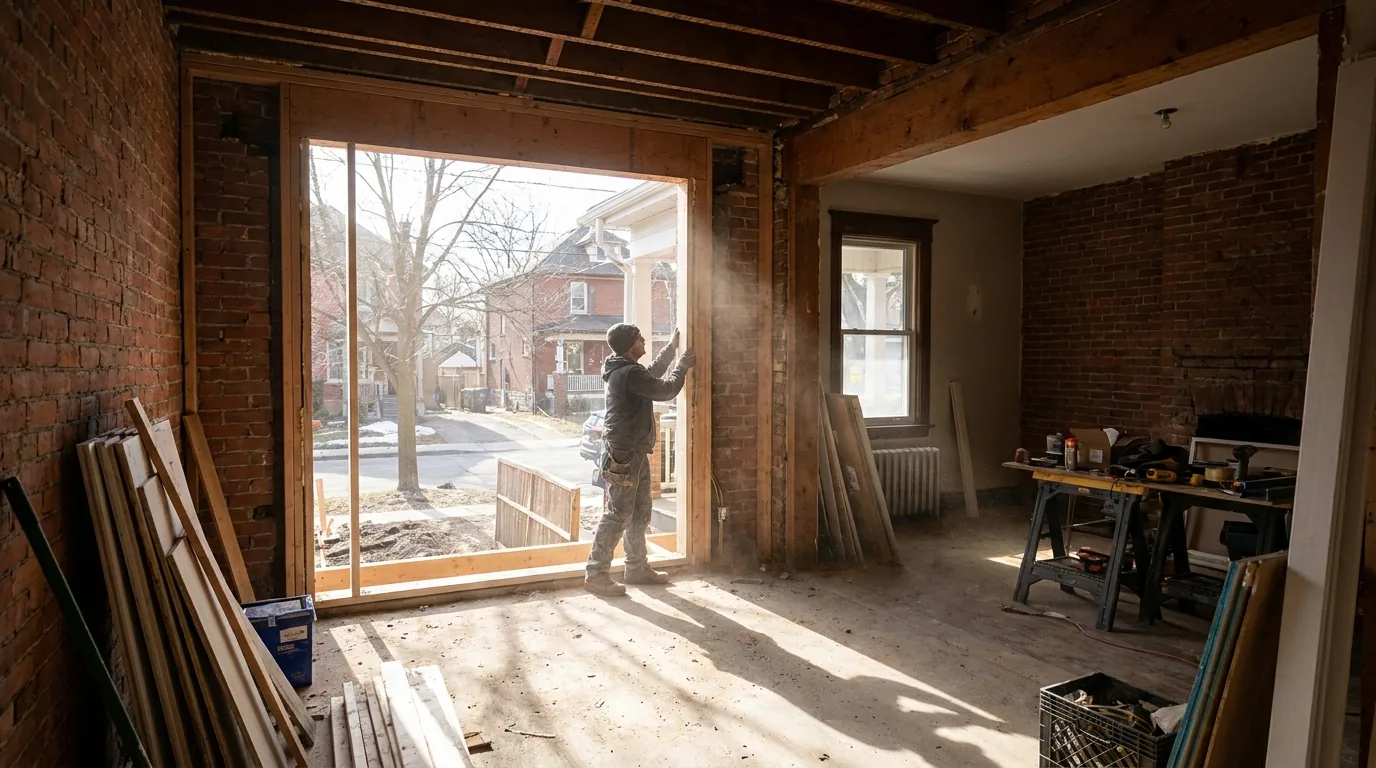
Ottawa homes get dark. Two-storey townhouses on tight Glebe lots, post-war bungalows in Alta Vista with original 30-inch windows, infill homes squeezed between neighbours twelve feet away. By 4:30 p.m. in January, you're flipping on every light in the house.
I've been adding light to dark Ottawa homes for two decades. Some moves are a quick weekend job. Others are a structural change that needs a permit and engineering. Here's the order I work through with clients.
Start with the sun, not the wall
Before you cut anything, sit in the room at three different times of day. Morning, mid-afternoon, and dusk. Note which walls catch sun and which sit dead.
Ottawa sits at 45.4 degrees north latitude. In December the sun barely climbs to 22 degrees above the horizon at noon. In June it pushes to 68 degrees. That's a 46-degree swing, and it changes which openings actually do work for you.
South walls deliver the most usable light year-round. East walls give you bright morning. West walls give you intense afternoon glare from May through September and very little from November to February. North walls give cool, even light that never burns out a sofa but never warms a kitchen either.
"The room you think is dark might just be facing the wrong wall. Sometimes the fix is moving the kitchen island, not adding a skylight."
Move 1: Skylights (the biggest hammer)
A 2x4-foot fixed skylight on a south or west pitch will change a room more than any window you can install in a wall. Roof openings catch sun all day because the sky is brighter than any vertical view.
What I spec in Ottawa:
- Velux fixed deck-mount for plain ceilings. Triple-glazed, low-E, argon-filled. Anything less and you'll get condensation streaks every February.
- Splayed shaft if the attic is deeper than 18 inches. A straight shaft lets light hit only the floor below; a splayed shaft (wider at the ceiling than the roof) bounces light across the whole room.
- Solar-powered blackout shades for bedrooms. Ottawa summer sunrise is 5:14 a.m. in late June.
- Flashing kit matched to your roof material. 90% of skylight leaks I've inspected were bad flashing, not bad skylights.
For a single fixed unit, the install scope includes the unit, drywall, paint, and the shaft. Vented or motorized units add hardware and wiring, which moves the number up.
Move 2: Sun tunnels (when a skylight won't fit)
Sun tunnels are flexible reflective tubes that funnel rooftop light through the attic into a ceiling diffuser. They're underrated.
Where they shine in Ottawa homes:
- Windowless powder rooms on the main floor
- Walk-in closets and pantries
- Stairwells and dark hallways
- Second-floor laundry rooms with no exterior wall
A 14-inch sun tunnel produces roughly the equivalent of three 60-watt bulbs on a sunny day, with zero electricity. The installed cost is driven mainly by attic run length and ceiling location.
Heritage warning
If your home is in the Glebe, Sandy Hill, New Edinburgh, or any designated Heritage Conservation District, skylights and rooftop alterations on street-facing slopes need Heritage approval. The rear slope is usually fine. Ottawa Heritage staff turn around feedback in 4-6 weeks; build that into your schedule.
Move 3: Transom windows above doors and walls
Transoms are the cheapest borrowed-light trick in the book. A 12-inch fixed glass strip above an interior door pulls daylight from one room into another without losing privacy.
Best applications I've done:
- Above the door from a bright kitchen into a dark dining room
- Above an interior wall between a sun-drenched living room and a back-of-house office
- Across the top of a stairwell wall to throw upstairs light into the foyer
Frosted or reeded glass keeps the privacy. Clear glass works above doors that don't need it. Cost per opening is driven by the glass spec and framing.
Move 4: Glass interior doors
Solid-core wood doors block 100% of borrowed light. A French door, a single panel of reeded glass in a frame, or a full-glass barn door will pull daylight from one room to the next without changing the floor plan.
I push glass doors hardest in two situations. First: between a bright south-facing living room and a dark home office tucked against a north wall. Second: at the bottom of a staircase to a finished basement, where you want light to pour down into the stairwell instead of dead-ending at a wood slab.
Spec reeded or fluted glass if the room behind needs visual cover. Spec clear glass if you want maximum borrowed light.
Move 5: Expand existing windows
Sometimes the simplest move is making the holes you already have bigger. A standard 30x48-inch window in a 1960s bungalow replaced with a 60x60-inch fixed unit changes the room dramatically.
Things to check before you commit:
- Is it a load-bearing wall? Adding width means adding a header, which means engineering and a permit.
- Setback and lot coverage. Bill 23 reforms loosened a lot of zoning rules in Ottawa, but window enlargement on a side wall still needs to respect privacy buffers. Our building permits team handles this on day one.
- Brick or stucco exterior? Cutting brick adds masonry work and a steel lintel to the scope.
- Heritage district? Front-facing window enlargement almost always needs heritage approval. Side and rear are easier.
Cost drivers per opening: the new window, cutting, the header (and any engineering), drywall, and exterior patching. A load-bearing wall and a brick exterior both push the number up.
Move 6: The light-colour palette
Once the holes are cut, the paint and finishes do the rest. Dark walls absorb light. Light walls bounce it.
For Ottawa rooms with limited natural light, I default to:
- Walls: Benjamin Moore Pale Oak OC-20 or Edgecomb Gray HC-173. Both have warm undertones that read soft, not sterile, in low winter light.
- Trim and ceilings: Simply White OC-117. Crisp without going icy.
- Floors: Light to mid-tone oak. Dark walnut or ebony floors will eat 30% of your daylight.
- Window treatments: Top-down/bottom-up cellular shades or simple linen panels mounted close to the ceiling. Heavy drapes that puddle on the floor cost you light.
Mirrors opposite a window double the apparent light without any construction. A 36x60-inch mirror across from a south window can turn a dim hallway into a bright one.
Putting it all together
For most Ottawa homes I work on, the light plan layers three or four moves at once. A typical project: skylight in the kitchen, sun tunnel in the powder room, transom above the office door, repaint the whole main floor in Pale Oak. We put the full scope on paper as a detailed written breakdown, and the house feels like a different building.
The most common mistake to avoid: don't pour money into a single big window if your real problem is a dark wall colour and a closed-off floor plan. Order matters. Layout, paint, holes, fixtures. In that order.
One more move: light the room electrically the right way
Even with all the daylight moves done, Ottawa winter days are short. Electrical lighting matters more here than it does in cities further south. The biggest mistake I see in older Ottawa homes: a single 60-watt bulb in the centre of the ceiling, flat on, with no layers.
What I spec instead, on every dim-room project:
- Recessed cans on a perimeter spacing of 4-5 feet, dimmable, 2700 K to 3000 K bulbs.
- One floor lamp or table lamp per seating area, plugged into a switched outlet so it triggers on the wall switch.
- Wall sconces flanking the fireplace or art for vertical light at eye level (most rooms only have horizontal ceiling light, which flattens everything).
- Under-cabinet lighting in any kitchen, even a small one. Adds usable counter light and a soft after-hours glow.
The principle: layer three sources at three heights. Ceiling, eye-level, and counter or table. A room with one source at one height feels like an office. A room with three sources feels like a home.
Dream Touch has been doing whole-home Ottawa renovations since 2005. We've added light to over 500 projects across Centretown, the Glebe, Manotick, Kanata, Stittsville, and everywhere in between. If you want a free 48-hour walkthrough on what's possible in your home, call 613-862-4555.