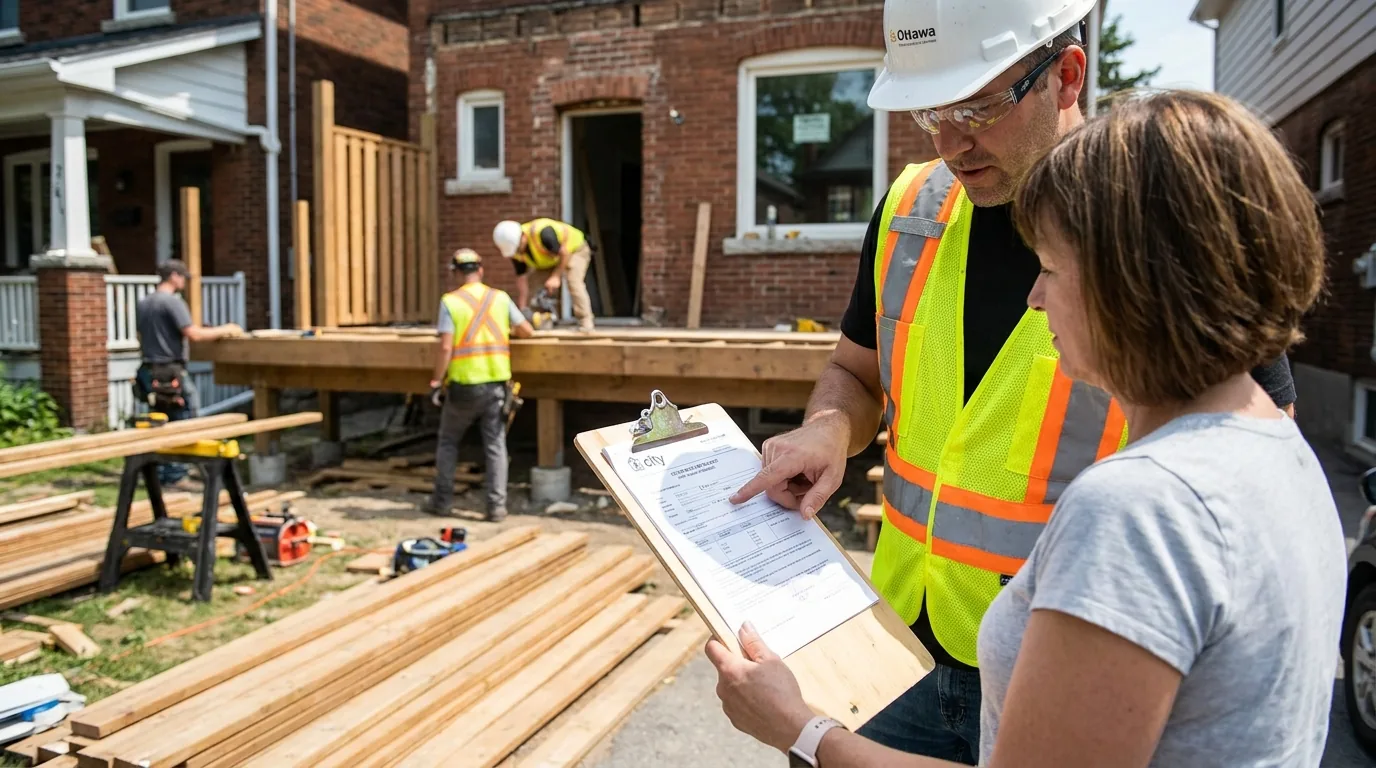
This is the question that surprises Ottawa homeowners every time. They assume that "contractor" is a regulated profession, like nursing or accounting. They assume that the city issues a licence, that there's an exam, that there's a registry the homeowner can check. None of that exists in Ontario for general contractors.
Ontario has no general contractor licence. There is no provincial body that licenses, regulates, or registers renovation contractors as a profession. The City of Ottawa does not issue contractor licences either. Anyone in Ontario can call themselves a renovation contractor, hang a sign, and start taking deposits, with no government check on whether they know what they're doing.
That's the bad news. The good news is that several specific things are regulated, and learning what they are tells you exactly what to verify before you hire anyone.
What is not licensed
To be specific about what's missing: Ontario does not require general renovation contractors to hold a provincial licence. The City of Ottawa does not require a municipal contractor licence for general renovation work. There is no provincial registry of renovation contractors that homeowners can search.
This is unusual compared to many other provinces. British Columbia regulates residential builders through BC Housing. Quebec licenses contractors through the RBQ. Manitoba and Nova Scotia have their own registration systems. Ontario simply does not.
What this means in practice: when a homeowner asks a contractor "are you licensed?" the contractor's answer is functionally a yes-no question that doesn't have a clean answer. There's no licence to hold or not hold. The honest answer is: "There's no general contractor licence in Ontario, but here's what we are required to carry, and here's what we voluntarily hold."
What IS legally required
Despite the absence of a general licence, Ontario contractors operating in Ottawa must hold three things by law:
WSIB coverage. Any business with employees in Ontario must register with the Workplace Safety and Insurance Board and carry coverage. The clearance certificate is a free, downloadable document showing the business is in good standing. It updates every 60 days. A renovation contractor without a current WSIB clearance is operating illegally.
Commercial liability insurance. Not technically required by Ontario law, but required by virtually every City of Ottawa permit application and by any homeowner with a real contract. Industry standard is $2 million in commercial general liability coverage. The certificate of insurance shows the policy holder, the coverage amount, and the expiry date.
Business registration. The contractor must be registered with the Ontario government as either an incorporated business (Inc., Ltd., Corp.) or a registered sole proprietorship with a master business licence. A contractor operating with no business registration is technically violating Ontario's business name registration laws and cannot legally enter contracts in the registered business name.
BCIN: required where design is involved
BCIN stands for Building Code Identification Number. It's the registration that lets a designer prepare and stamp permit drawings for residential houses in Ontario. The Ministry of Municipal Affairs and Housing regulates it.
BCIN is required when the design work falls under the Ontario Building Code's "house" category, which covers most residential renovations: kitchen and bathroom layouts when permits are required, basement legalization, additions, second-storey adds, coach houses, and any structural changes that need stamped drawings.
A contractor cannot legally sign permit drawings for these projects without holding BCIN registration in the appropriate categories (typically "House" plus "Small Buildings" or "Large Buildings" for commercial work). The drawings need to be reviewed and stamped by a BCIN-registered designer, or alternatively by an architect or professional engineer.
At Dream Touch we hold BCIN designation, which is what lets us provide design and permit work in-house rather than referring out to a separate designer. Most Ottawa renovation contractors don't carry BCIN themselves; they sub the design out, which adds 4 to 8 weeks to project timelines.
The BCIN check
If a contractor claims to be BCIN-certified, you can verify on the Ontario Ministry's BCIN registry. Their name, registration number, and active categories are public. A contractor who says "BCIN" but isn't on the registry is not actually registered. Real BCIN designers list their number on every set of drawings.
The trades that ARE individually licensed
Three specific trades require individual licensing in Ontario. The contractor doesn't need to hold these personally, but the people doing the actual work do. This is where the licensing question gets concrete.
Electricians. The Electrical Safety Authority (ESA) licenses electrical contractors and certifies electricians. An ECRA/ESA contractor licence is required for any business doing electrical work in Ontario. Individual electricians need to hold a Certificate of Qualification (309A for construction and maintenance, 309C for industrial). Every electrical permit pulled in Ottawa must be pulled by an ESA-licensed contractor.
Plumbers. Plumbing requires a Certificate of Qualification under the Ontario College of Trades framework. The trade is regulated, the certificate is required, and the contractor pulling the plumbing permit must be either a licensed plumber or have a licensed plumber on staff.
Gas fitters. Anyone touching natural gas lines (gas stove install, gas dryer install, BBQ hookups, fireplace install) must hold a TSSA (Technical Standards and Safety Authority) gas fitter licence. There's no exception for "small" gas work. The licence is mandatory and the inspection is non-negotiable.
For these three trades, the question "are they licensed?" has a clean answer: yes or no. There's a number you can look up. There's a regulatory body that issues and revokes the licence. The protection is real.
What a contractor's "licence" actually consists of
Putting it together: when a competent Ottawa renovation contractor describes their credentials, the real answer looks like this:
- Ontario business registration (corporation or master business licence)
- HST number with Canada Revenue Agency
- WSIB clearance certificate, current within 60 days
- Commercial liability insurance, $2M minimum, certificate available on request
- BCIN designation if the contractor does design and permit work in-house
- ECRA/ESA contractor licence number for electrical work, or the named licensed electrician sub
- Certificate of Qualification holder for plumbing, or the named licensed plumber sub
- TSSA gas fitter licence holder for gas work, or the named licensed gas fitter sub
That's the actual answer to "are you licensed?" There's no single document. There's a stack of registrations, certifications, and trade licences that together cover the regulated parts of the work.
What "licensed and insured" usually means
You'll see "licensed and insured" on Ottawa contractor websites and trucks. The phrase is doing a lot of work, and it's worth unpacking what each word means.
"Licensed" usually refers to one of two things: the business registration with the Ontario government (which is mandatory for any business name) or the master business licence for sole proprietors. Both are paperwork registrations, not professional licences. "Licensed" rarely means anything more than "we've registered our business," because there is no general contractor licence to hold.
"Insured" usually refers to commercial liability insurance. The amount and coverage matter. $1M coverage is below the Ottawa industry standard; $2M is standard; $5M is what larger contractors carry. The certificate of insurance shows the actual coverage, not the website claim.
The phrase "licensed and insured," then, can be true while still meaning very little. The substance is in the specifics: which registrations, what coverage, what trades licensed.
The absence of an Ontario contractor licence isn't a loophole; it's the whole picture. Verify the specific things that ARE regulated, and don't assume the word "licensed" covers anything else.
Why this matters when something goes wrong
The licensing structure determines what recourse you have when a project goes sideways. With trades that are licensed (electrical, plumbing, gas), you can file a complaint with the regulatory body (ESA, College of Trades, TSSA). Bad work can be investigated, licences can be suspended, and there's an enforcement mechanism.
For general contractor work, your only recourse is the contract you signed and civil court. There's no provincial regulator to complain to, no licensing body to investigate, no public registry of "bad contractors" being expelled from the profession. The Ontario Consumer Protection Act provides some protection, but it's slow and costly to enforce.
This is why the contract you sign before construction matters more than people realize. The contract is the only document that stands between you and a contractor with no professional licence to lose. Make it specific. Make it complete. Make it enforceable.
The verification checklist
Before signing with any Ottawa contractor, verify these in writing:
- Ontario business registration (look up on the Ontario business name search)
- WSIB clearance certificate (request copy, valid within 60 days)
- Commercial liability insurance certificate ($2M minimum, current)
- HST number on the quote
- BCIN registration number if design is part of the project (verify on Ministry registry)
- ECRA/ESA contractor number or named electrical sub
- Plumbing Certificate of Qualification holder named
- TSSA gas fitter named if gas work is involved
Each of these is a 5-minute verification. Together they tell you whether the contractor is operating legally, whether they have the insurance to back up what they're doing, and whether the licensed trades they're using are real.
It isn't paranoia; it's how Ottawa renovation actually works. The absence of an overall contractor licence puts the verification responsibility on you. Once you know what to check, the check is fast. The contractors who pass are the ones running real businesses.