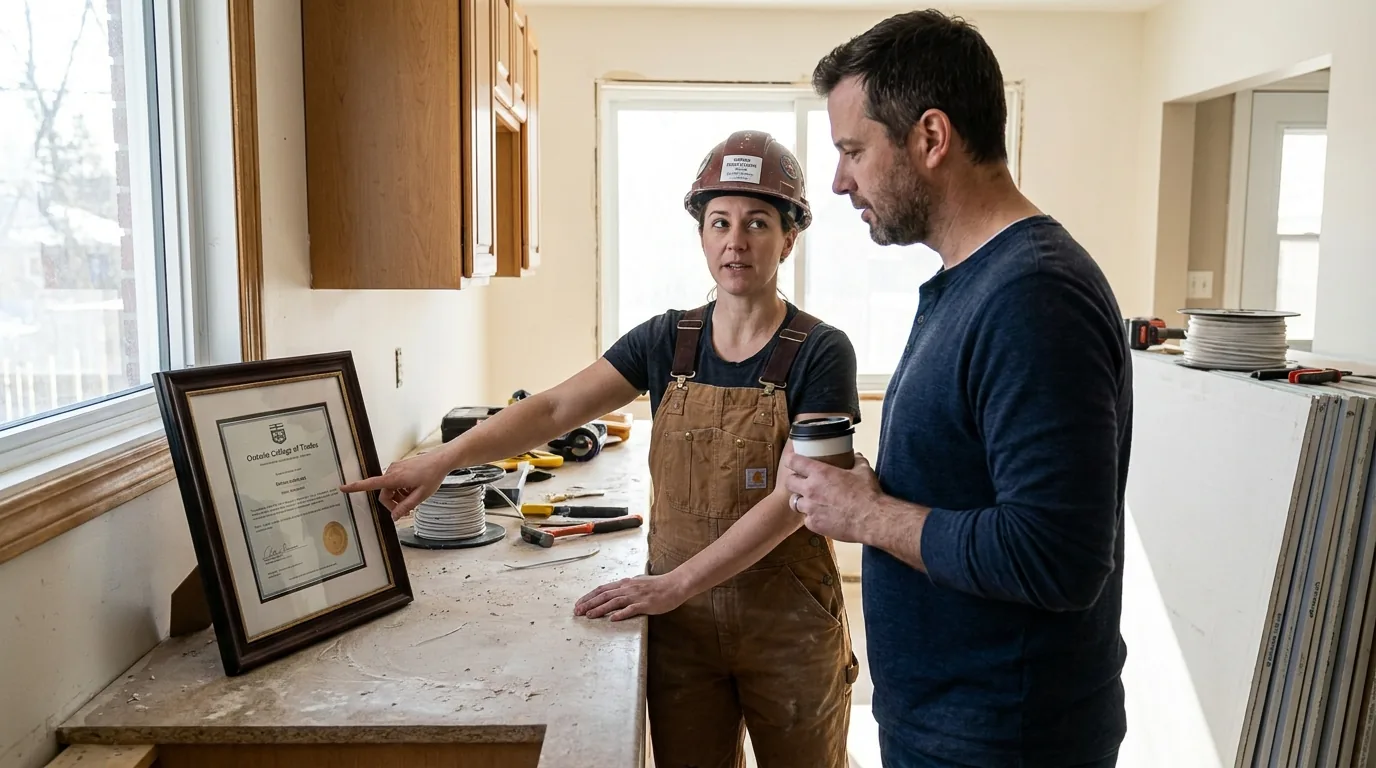
A homeowner in Centretown called us last fall after a "kitchen guy" she'd hired to add a stove circuit had blown the main breaker twice and installed a 30-amp wire on a 50-amp circuit. The "kitchen guy" wasn't a licensed electrician. He was a handyman with a confidence problem. Fixing his work cost her three grand and a panel inspection, on top of the original bill she'd already paid him.
This happens constantly in Ottawa. Not because homeowners are careless, but because Ontario's trade licensing rules are not obvious. Some trades are compulsory and some are voluntary. Some get licensed by Skilled Trades Ontario, some by ESA, some by TSSA, and some by nobody. The labels people use ("certified electrician," "licensed plumber," "qualified gas tech") are sometimes accurate and sometimes marketing.
Here's the actual structure of Ontario trade licensing for renovation work, what each licence really means, and how to verify a tradesperson before they touch your house.
The compulsory trades
Ontario has a list of compulsory certified trades. If you work in one of these trades, you're legally required to hold a current Certificate of Qualification from Skilled Trades Ontario, or be a registered apprentice working under a journeyperson who holds one. The list relevant to residential renovation includes:
- Electrician (Construction and Maintenance Electrician, 309A), every electrical wire in your house must be installed by a licensed electrician or apprentice working under one.
- Plumber (306A), water supply and drain-waste-vent piping, including connections to fixtures.
- Refrigeration and Air Conditioning Mechanic (313A). HVAC work involving refrigerant lines.
- Sheet Metal Worker (308A), ducting fabrication for HVAC.
- Gas Technician (G2 or G1), licensed by TSSA, not Skilled Trades Ontario, but compulsory for any gas line work.
If a worker in any of these trades shows up to your house and isn't licensed, the work is illegal regardless of how good it looks. ESA can fail the inspection, the city can fail the building permit, and the homeowner can be on the hook for tear-out and re-install at full cost.
The voluntary trades
The other trades are voluntary. You don't need a Certificate of Qualification to legally work as a:
- General carpenter
- Drywaller
- Tiler
- Painter
- Cabinet maker
- Hardwood installer
- Roofer (in most municipalities; some require a roofing licence)
- Insulator
- Mason
This is where most of the renovation labour pool lives. The good news: many voluntary tradespeople do hold the Skilled Trades Ontario Certificate of Qualification anyway, because they apprenticed properly and got it. The bad news: many don't, and the law doesn't require them to.
"Voluntary" doesn't mean "unimportant." A bad tile installer can ruin an entire bathroom renovation. A bad framer can build a wall out of square that nothing on top of it will fit cleanly. The reason these trades stay voluntary is political, not technical, and it puts the burden on the homeowner and the general contractor to vet skill some other way: portfolios, references, years on the job, employer reputation.
What ESA actually licenses
The Electrical Safety Authority is a separate animal from Skilled Trades Ontario. ESA does two things relevant to renovation:
1. ESA licenses electrical contracting businesses. An ESA-licensed electrical contractor (LEC) is a business that carries the right insurance and meets the regulatory requirements to pull electrical permits in Ontario. The licence is for the business, not the individual. The business must employ at least one Master Electrician.
2. ESA inspects electrical work. When your electrician pulls a permit (called a Notification), ESA assigns an inspector to come check the work at the rough-in stage and again at final. The inspector certifies that the work meets the Ontario Electrical Safety Code.
The ESA licence number on a quote should be verifiable. Search "ESA Find a Contractor" on the ESA website, type in the contractor's name or licence number, and the registration appears. If it doesn't, the licence is fake or expired.
The ESA permit test
If you're getting electrical work done as part of a renovation, ask the contractor for the ESA notification number after they pull it. Notification numbers look like ESA-followed-by-digits. You can verify the notification on the ESA portal. No notification means no permit. No permit means no inspection. No inspection means the work is invisible to the system, and you have no recourse if it fails.
What TSSA actually licenses
TSSA (Technical Standards and Safety Authority) licenses gas work. There are two tiers relevant to residential renovation:
- G2: most residential gas work (gas ranges, dryers, water heaters, furnaces under a certain BTU).
- G1: commercial scale gas work and certain residential equipment above the G2 threshold.
TSSA also licenses gas-fitting businesses (ROCP, Registered Operating Contractor Programme) that pull gas permits. Like ESA, the licence number is verifiable on the TSSA public registry.
Gas work without a TSSA-licensed technician is illegal and dangerous. A gas range hookup that leaks even slightly will eventually find an ignition source. Insurance companies do not pay for fires caused by unlicensed gas work, and the homeowner is left fighting both the loss and the insurer.
The general contractor isn't licensed by anyone
Here's the part that surprises homeowners. In Ontario, there's no provincial licence to operate as a residential general contractor. Anyone can call themselves a contractor, register a business name, and start quoting jobs. There's no exam, no certification, no required course.
What there is:
- BCIN: Building Code Identification Number, required for anyone preparing building permit drawings or designs as a paid service. The BCIN is held by individuals, not businesses, and is administered by the Ministry of Municipal Affairs and Housing.
- HCRA: Home Construction Regulatory Authority, which licenses new home builders and vendors under the Tarion warranty system. HCRA does not regulate renovation contractors. Renovations are not Tarion-covered work.
- WSIB: Workplace Safety and Insurance Board registration, required for any business with employees. Not a quality licence; a workplace insurance requirement.
- Municipal business licence: some Ottawa renovation work requires a city business licence, but this is mostly an administrative filing, not a quality bar.
This is why the contractor selection burden falls on the homeowner. There's no central registry to check.
The Ontario residential renovation industry is built on a presumption that the homeowner does the qualification check. Most homeowners don't know that, and most contractors quietly hope they won't.
How to verify a tradesperson before they start
Whether you're hiring directly or hiring a general contractor who'll be hiring trades, ask for and verify the following before any work happens:
- Skilled Trades Ontario Certificate of Qualification number for any compulsory trade (electrician, plumber, sheet metal, refrigeration). The number is verifiable on the Skilled Trades Ontario public lookup.
- ESA Licensed Electrical Contractor (LEC) number for the electrical contracting business. Verify on the ESA portal.
- TSSA G2 or G1 number for any gas tech, plus the ROCP number for the gas business. Verify on the TSSA registry.
- WSIB clearance certificate for the general contractor and every trade business on site. Dated within 60 days. The contractor can request these for you.
- Liability insurance certificate for the general contractor showing a two-million-dollar minimum. The certificate should name the homeowner as additional insured for the project.
- BCIN number if the contractor is preparing the permit drawings themselves. Verifiable on the Ministry's BCIN search tool. Required for our permit and design service by law.
- References from the past 12 months with phone numbers, not just photos. Real homeowners who finished real projects.
The handyman category
"Handyman" isn't a regulated term in Ontario. It usually means a generalist who can do small repairs (a leaky tap, a rotten board, a sticky door, a paint touch-up). Some handymen are excellent. Some are dangerous.
The handyman test is task-by-task. A handyman replacing a doorknob is fine. A handyman re-tiling a backsplash is probably fine. A handyman wiring a new outlet is committing a Section 113 ESA violation. A handyman moving a gas line is committing a TSSA offence.
If a handyman offers to do compulsory-trade work in your house, the answer is no, every time. The legality and the insurance both fail. Even if the work is technically clean, the inspection won't happen, the future homeowner's lawyer will catch it on the disclosure, and you'll pay to redo it on resale.
What the right structure looks like
A clean Ontario renovation has a clear chain. The general contractor (uninsured by anybody as a contractor licence, but qualified through reputation, BCIN, WSIB, insurance, and references) hires the appropriate compulsory trades (licensed by Skilled Trades Ontario, ESA, or TSSA), pulls the permits (City of Ottawa for building, ESA for electrical, TSSA for gas), and supervises the voluntary trades (qualified through portfolio and reputation).
If any link in that chain is missing, the project is exposed somewhere. The expensive places to be exposed are electrical, gas, and structural, in that order. The cheap places to be exposed are tile, paint, and finish carpentry. Cheap problems show up in week 12 as a cosmetic disappointment. Expensive problems show up in year 5 as a fire, a flood, or a wall that won't pass an inspection on resale.
If you want to skip the qualification check entirely, hire a general contractor who runs an in-house team and uses verified compulsory trades for the licensed work. That's how we run our jobs at Dream Touch, and it's the reason we sleep at night. If you'd like to see the licence and insurance documents from a real Ottawa renovation, we'll bring them to your free 48-hour feasibility review and walk through the verification step by step.