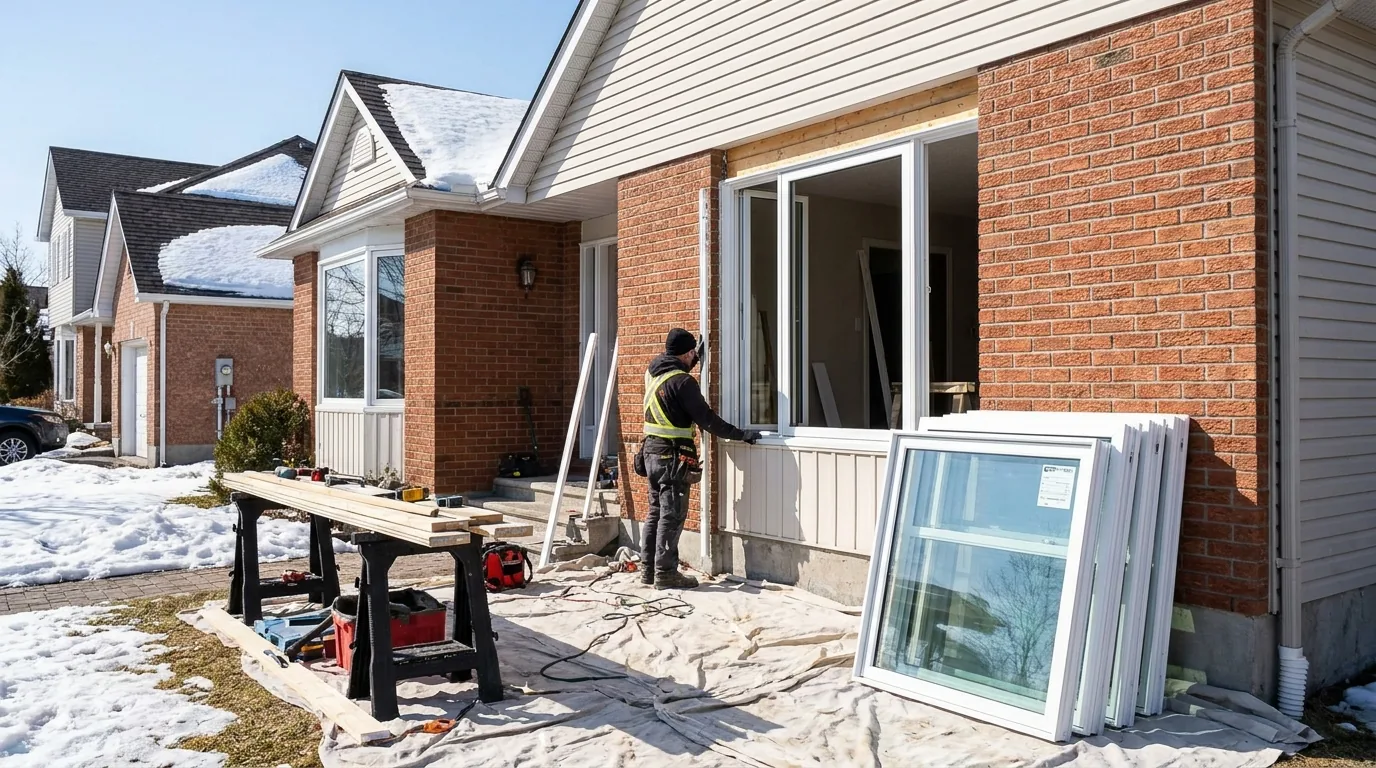
Window quotes in Ottawa vary widely for what looks like the same opening from the street. The spread is real and the reasons for it are physical: insert versus full-frame, double-pane versus triple-pane, vinyl versus wood, casement versus hung, brick-mould versus standard exterior. Each of those choices is a cost driver, and a clear written proposal should itemize which ones apply to your home.
Below is what each tier physically gets you, what moves the price up or down, and why Ontario's window rebate program is no longer a real factor in the math.
What drives per-window pricing
"Installed" here means: window unit, supply and install labour, basic foam insulation around the frame, interior trim repaint touch-up, exterior caulking, and disposal of the old window. Standard size is 36 inches by 48 inches. Larger windows scale up roughly linearly per square foot, which is one of the first variables an estimator confirms.
- Vinyl insert, double-pane: the entry-level scope. Lowest material and labour input of the tiers below.
- Vinyl insert, triple-pane: the mid-tier most Ottawa homes land on. Adds glazing performance over the double-pane unit.
- Vinyl insert, triple-pane, premium brand (Pella, Marvin, Andersen): branded hardware and warranty add to the unit cost.
- Vinyl full-frame replacement (replacing the entire frame including the buck): a clear step up over insert pricing because of the added demolition, framing, and exterior work.
- Fiberglass frame, triple-pane: a stronger, more stable frame material at a higher unit cost than vinyl.
- Wood frame with aluminum cladding: premium material with more finishing labour.
- Brick-mould wood frame (heritage replacement): the top tier, driven by custom milling and masonry work (see below).
Insert vs full-frame: the most important question
An insert replacement keeps your existing window frame in place and slips a new window unit inside it. Faster, cheaper, no exterior disturbance. Works if your existing frame is sound.
A full-frame replacement removes the entire window including the wood buck (the structural frame inside the wall), inspects what is behind it, and installs a new buck and new window. Slower, more expensive, but it is the only way to address rotted framing or air leakage at the perimeter.
For pre-1990 Ottawa homes (built when window frames were often softwood and air sealing was minimal), full-frame is usually the right call. The original frame has likely had moisture damage at the sill, and an insert just hides that problem behind a new sash.
For post-2000 homes with sound original framing, insert replacement is fine and meaningfully cheaper per window because it skips the demolition and re-framing scope.
How to tell if your existing frames are sound
Open every operable window. Push a small screwdriver gently into the wood at the bottom of the frame, on the inside corners, and at the sill. If it goes in more than 2mm, the wood is soft and rotted. Full-frame replacement is the right call. If the screwdriver hits firm wood everywhere, an insert replacement will work.
Casement vs hung vs slider
Window operation type affects price and energy performance.
Casement (cranks open like a door): the strongest air seal of any operable window. The compression seal pulls tight against the frame when locked. Best choice for Ottawa winter performance. Pricing as listed above.
Single-hung or double-hung (slides up): standard for older homes and for spaces where a casement crank would interfere with a kitchen counter or door. Air seal is slightly worse than casement because the seal has to allow the sash to slide. Typically a touch cheaper per window than an equivalent casement.
Slider (slides side to side): common in 1960s through 1980s Ottawa homes, basement windows, and over-counter kitchen windows. Worst air seal of the three operable types. Pricing similar to single-hung.
Fixed (does not open): best air seal because there is no operating mechanism. Cheaper than any operable window of the same size. Use for spaces that do not need ventilation (above bathtubs, in stairwells, in non-egress bedrooms).
If energy performance matters, every operable window should be casement. The price difference is small and the air seal advantage compounds over a 25-year window life.
Triple-pane is mandatory for Ottawa
Standard double-pane in Ottawa is a budget choice that costs the homeowner energy bills for the next 25 years. Triple-pane adds roughly 10 to 20 percent to the window cost and reduces winter heat loss by roughly 30 to 40 percent on the same opening.
The math: a 36 by 48 inch double-pane window has a U-value around 0.30. The same window in triple-pane runs U-value 0.18 to 0.22. Heat loss is roughly proportional to U-value, so the lower U-value lowers your heating bill every winter for the life of the window.
Across the 25-year life of the window, the heating savings from triple-pane outweigh the modest glazing upcharge by a wide margin. The decision is not close in Ottawa.
Why brick-mould wood frames cost three times more
Heritage Ottawa homes (Glebe, Sandy Hill, Centretown, Old Ottawa South, parts of Westboro) often have wood-frame windows with brick mould trim, which is a specific exterior wood profile that sits between the brick veneer and the window sash. Replacing these windows with vinyl inserts changes the look of the home significantly and is sometimes prohibited under heritage permit conditions.
A faithful brick-mould wood window replacement is the most expensive tier because:
- The window unit itself is custom-milled wood (often pine or fir), not a stock vinyl pull.
- The brick mould profile is specific to the home's era and has to be milled to match.
- Installation requires careful brick masonry work to remove the old window without damaging the brick reveal.
- Painting and finishing the wood requires multiple primer coats, two finish coats, and protection during cure time.
For a homeowner in a heritage district who values the original look, this premium is real. For a homeowner who can switch to a quality fiberglass frame in a similar profile (Pella Lifestyle, Marvin Elevate), the cost drops significantly and the energy performance is better than wood.
Whole-house window replacement: what shapes the total
A typical Ottawa two-storey has 12 to 18 windows. A typical bungalow has 8 to 14 windows. The whole-house total is mostly a function of window count multiplied by the tier you choose, so the same house can land at very different numbers depending on scope:
- Bungalow, mid-tier vinyl triple-pane insert: the most budget-conscious whole-house path for a smaller home.
- Bungalow, full-frame triple-pane: a step up because every opening adds demolition and re-framing labour.
- Two-storey, mid-tier vinyl insert: higher than a bungalow simply because there are more openings.
- Two-storey, fiberglass triple-pane: a premium-material upgrade across a larger window count.
- Heritage two-storey, brick-mould wood windows: the top of the range, driven by custom milling and masonry on every opening.
Plus add for any oversized fixed windows, picture windows, custom shapes (round, octagonal, arched), and bay or bow windows. A bay window is a notable add over three regular casements because of the extra structure, flashing, and seat detail. A detailed written breakdown should list each opening and its tier so you can see exactly where the budget goes.
Why Ontario rebates went away
The federal Greener Homes Grant program, which paid a per-square-metre amount toward window replacement, closed for new applications in early 2024. The Canada Greener Homes Loan, which provided low-interest financing for energy retrofits, also wound down.
Ontario's window-specific rebate programs operated through Save on Energy and through utility-led incentives. Most have ended or reduced their scope to commercial buildings.
What remains in 2026: a handful of municipal incentive programs (Ottawa's Better Homes Loan Program offers low-interest financing for energy retrofits including windows), some manufacturer rebates from the window company itself (typically already built into the pricing), and the federal tax credit for accessibility-related window upgrades.
If a window salesperson tells you about a large federal rebate available to you in 2026, ask them to put it in writing in the contract. The grant programs that paid out cash to homeowners are no longer accepting applications.
Real example: 1968 Nepean two-storey, 2025
14 original double-pane vinyl windows, 30 years old, sash seals failed on most. Owner thought they needed full-frame replacement. We did a full-frame test on three windows and found the bucks were sound (kiln-dried softwood, dry, no rot). Switched scope to insert replacement, casement format, triple-pane, across all 14 windows over four working days. The scope change saved the owner the full-frame demolition and re-framing cost on every opening, and the energy upgrade was identical.
For full-home renovation scope including window upgrades, see our Ottawa home renovation page.
Bottom line: a quality vinyl triple-pane insert is the right baseline for most Ottawa homes. Step up to fiberglass frames if you want a stronger, more stable material, and reserve wood brick-mould profiles for a heritage requirement. Triple-pane is mandatory in Ottawa; double-pane is a 25-year mistake. Call 613-862-4555 for a detailed written window quote that itemizes every opening and tier.