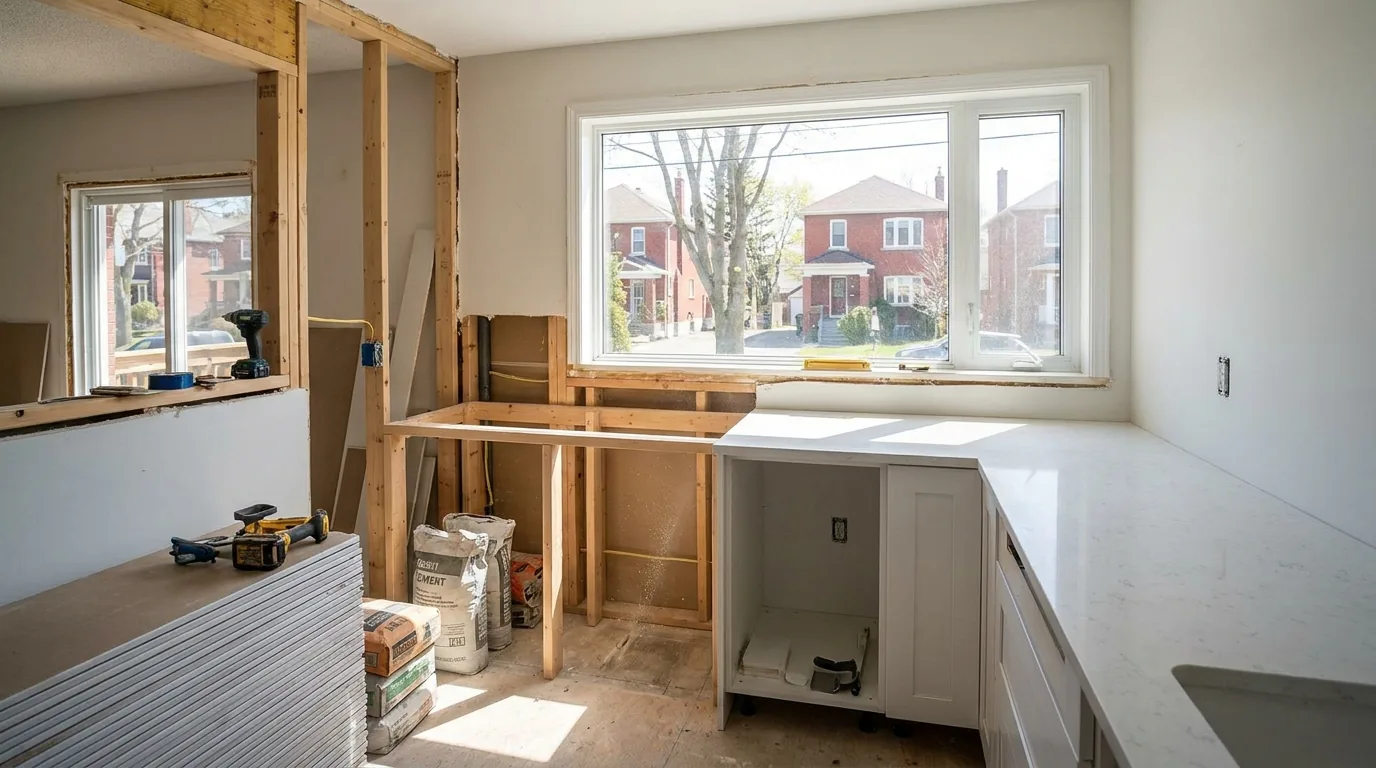
A Findlay Creek client called us in February with a major basement and main-floor scope and said her bank had offered her two options: refinance the mortgage to roll the renovation into one payment, or open a HELOC. She asked which one we recommend.
The honest answer: the right one depends on three numbers, and most homeowners do not know all three until a mortgage broker pulls them. Below is the math, the trap that catches half the homeowners who refinance, and three real Ottawa scenarios with the answer worked out.
What each one actually is
A HELOC (home equity line of credit) is a revolving line of credit secured by your home. The lender approves a credit limit (up to 65 to 80 percent of appraised value minus your existing mortgage), and you draw what you need. Interest accrues only on the drawn portion. Pay it back any time without penalty.
A mortgage refinance means breaking your current mortgage early, paying any associated penalty, and signing a new mortgage at a higher principal that includes the renovation amount. The renovation money becomes part of your regular monthly mortgage payment, amortized over 25 or 30 years.
The HELOC is flexible and faster. The refinance is structured and disciplined. Each one has scenarios where it is clearly correct.
The three numbers that decide it
Before either option makes sense, you need three numbers from your existing mortgage and your current rate environment.
- Your current mortgage rate. Locked-in interest rate on the term you signed.
- Your prepayment penalty. Either three months of interest OR an Interest Rate Differential (IRD) calculation, whichever is greater. Banks calculate this automatically; ask for the exact dollar amount.
- Today's offered renewal rate. What the bank will give you on a new 5-year fixed or variable.
If the IRD penalty is small (your current rate is at or below today's offered rate), refinancing is cheap and clean. If the IRD penalty is large (your current rate is well above today's offered rate), refinancing can cost thousands in penalty before you save a dollar in interest.
The IRD penalty trap
If you signed a mortgage in 2022 at 5.49% and today's 5-year fixed is 4.79%, breaking your mortgage to refinance triggers an IRD penalty calculated on the rate spread for the remaining term. On a large balance with three years left, the IRD can run into five figures, enough to wipe out three to four years of interest savings on the renovation portion. Always ask the bank to email you the exact penalty quote in writing before you sign anything.
When HELOC wins
Four scenarios where a HELOC is clearly the better tool:
- Mid-term mortgage with a meaningful IRD penalty. If breaking the mortgage triggers a sizable penalty, the HELOC sidesteps it entirely. You leave your existing mortgage alone and add the renovation as a separate facility.
- Phased renovation with money drawn over time. A renovation that runs 6 to 12 months means you only borrow as you go, paying interest on a small balance early and a larger one as the work progresses. A refinance dumps the full amount into your principal on day one and you pay interest on the whole sum from the start.
- Aggressive payback plan. If you plan to clear the renovation debt in 18 to 36 months, the HELOC's flexibility wins. Refinances spread the cost over 25 years; HELOCs let you crush the principal whenever cash arrives.
- Uncertainty about final scope. If your contractor is fixed-price but allowance items might shift, the HELOC limit gives you headroom without restructuring debt.
When refinance wins
Three scenarios where refinancing actually beats the HELOC:
- Mortgage at or near renewal. If you are within 4 months of renewal, the IRD penalty drops to zero or near-zero. Refinancing at renewal lets you roll the renovation into the new term at mortgage rates (typically 1.0 to 2.0 percent below HELOC rates) with no penalty.
- Long payback horizon and rate-spread advantage. If you intend to amortize the renovation cost over 15-plus years and the mortgage rate is 1.5 percent or more below the HELOC rate, the refinance saves real money over time. Over a long amortization, even a 1.5 percent rate spread compounds into meaningful savings.
- Fixed-budget personality. Some homeowners want one predictable monthly payment forever. The refinance gives you that. The HELOC requires monthly discipline; if interest-only payments tempt you to never pay down principal, the refinance forces the structure.
The math on a typical renovation
Assume a Westboro homeowner with a mid-term mortgage at 4.89% and 30 months remaining on a 5-year term. Today's environment: 5-year fixed mortgage 5.19%, HELOC at prime + 0.5% (6.45%). The bank quotes a substantial IRD penalty to break the mortgage early.
Refinance path: break the mortgage, pay the IRD penalty, and refinance the higher principal at 5.19% on a 25-year amortization. The monthly payment rises, and over the remaining 30 months you pay interest on the renovation portion at the mortgage rate. The total cost of borrowing is the penalty plus that interest.
HELOC path: open a HELOC limit, draw against it over 6 months as work progresses so the balance ramps up gradually, then carry the full amount for the remaining 24 months. Interest accrues at 6.45% on that phased balance, with no penalty.
In this case the HELOC wins clearly. The IRD penalty is the deciding factor; without it, the refinance saves money long-term thanks to the lower rate.
The IRD penalty is the variable that flips the answer. Without it, refinance usually wins. With it, HELOC almost always wins. Run that number first.
Three Ottawa scenarios with the call
Scenario A: Manotick couple, kitchen renovation. Mid-rate mortgage at 5.29% with only 8 months left on term.
The call: wait for renewal, then refinance. With only 8 months left, the IRD penalty is small but the timing argues for waiting. At renewal, roll the renovation into the new mortgage at the going rate. No penalty, mortgage-rate cost of capital, single monthly payment. If the renovation has to start before the renewal date, use a HELOC short-term and roll into the new mortgage at renewal.
Scenario B: Stittsville family, basement legalization for a rental suite. Low-rate mortgage at 4.49% with 32 months left.
The call: HELOC. The 4.49% mortgage rate is below today's offered rate, so the IRD penalty is mild but breaking a low-rate mortgage to take a higher-rate one makes no economic sense. Open a HELOC, draw as the basement work progresses, plan to pay it down with rental income within 4 to 6 years. The math favours the HELOC even ignoring penalties.
Scenario C: Centretown condo owner, bathroom and kitchen refresh. Higher-rate mortgage at 5.99% with 22 months left.
The call: refinance. The current rate (5.99%) is well above today's offered rate (5.19%), so the IRD penalty is small or zero. Refinancing rolls the renovation into a lower-rate mortgage and reduces the existing payment. The renovation gets funded at mortgage rates, and the homeowner saves on the existing balance simultaneously.
The flexibility tax
A HELOC's flexibility comes at a cost: roughly 1.0 to 1.75 percent more interest than a 5-year fixed mortgage. Over a five-year payback that rate spread adds up to real extra interest. The flexibility is only worth paying for if you actually use it (drawing in stages, paying back early, drawing again later).
If you draw the full amount on day one and pay it back on a strict 5-year schedule, you have paid the flexibility tax for nothing. In that case, refinancing was cheaper.
What to do before you call the bank
Three steps:
- Get the current mortgage rate, exact prepayment penalty, and remaining term in writing from your bank.
- Get today's offered fixed and variable rates from the same bank and one competitor.
- Get a fixed-price renovation quote from your contractor so you know the exact number you need to borrow.
Then run both scenarios with a mortgage broker. Most brokers do this analysis free; they make their money on the deal that closes, not on the consultation. The math is not complicated, but you cannot do it without the IRD penalty quote.
For more on how we structure deposits and progress payments around HELOC draws or mortgage advances, see the Ottawa renovation financing page. We accept either; the contract milestone schedule lines up with how either lender disburses funds. Phone 613-862-4555 if you want a fixed-price number you can take to your mortgage broker.