"Can you start next month?" is the question that ends most homeowner conversations with the better Ottawa renovation contractors, faster than any other. The honest answer is usually no, and the reason is math, not attitude.
Most homeowners don't realize how the capacity of a quality renovation business actually works. They assume that if a contractor is busy, they should hire more people and take more work. The math doesn't support that, and the result of trying to do it is usually a worse contractor.
Here's what the calendar of a competent Ottawa renovation contractor looks like, why a 6-month wait is a sign of health rather than a problem, and how to position yourself to actually get scheduled.
The capacity math
A typical mid-size Ottawa renovation contractor with one in-house crew and two project managers can run, comfortably, about 30 active projects per year. Some are 2-week bathrooms. Some are 6-month additions. Average duration across the mix is roughly 8 weeks. With overlap, the contractor has 4 to 6 jobs going at any one time.
Now look at the demand side. A contractor who's been operating in Ottawa for 15+ years, with 4.7-star reviews and a local reputation, gets roughly 8 to 12 inquiries per week from homeowners ready to buy. That's 400+ inquiries a year for 30 slots.
The contractor cannot serve everyone. They have to qualify, prioritize, and book ahead. The waitlist isn't a marketing tactic. It's the natural state of supply meeting demand at a specific quality level.
The contractor who can start next week has either dramatically over-staffed (which means they're carrying high overhead and pricing accordingly) or has very few clients booked (which means something else, usually that they aren't getting referrals).
What "6 months out" really means
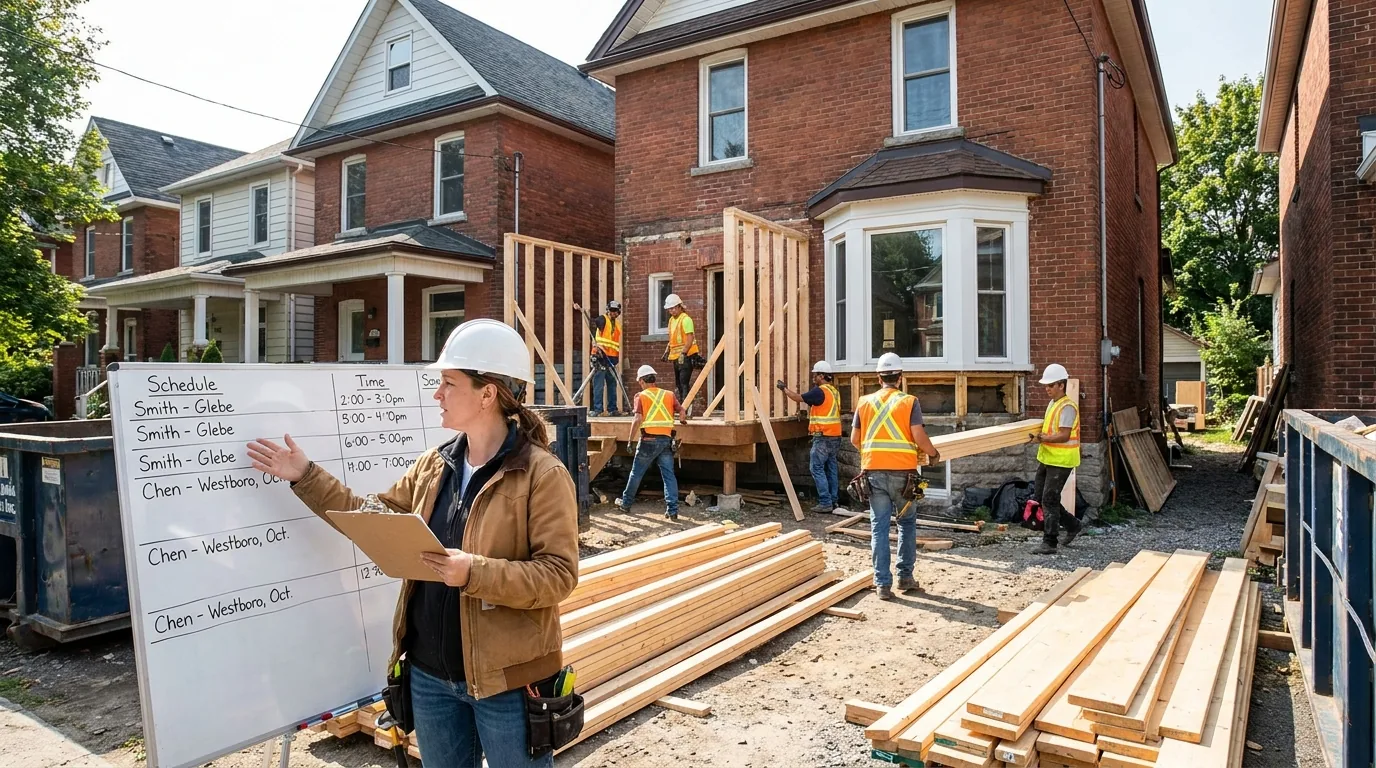
When an Ottawa contractor says "we're booked 6 months out," they mean their crew's calendar is full for the next 6 months. New projects starting today are slotted into October, November, December.
This is normal in residential renovation. The reasons are mechanical:
- Permit timelines. A typical permit-required project (most kitchens with electrical changes, all bathrooms with new plumbing, all additions, all basement legalizations) needs 6 to 12 weeks for design and permit before construction can start. The 6-month wait usually includes that design/permit window.
- Material lead times. Custom cabinets are 8 to 12 weeks. Custom windows are 6 to 10 weeks. Tile from Italy is 8 to 16 weeks. The contractor has to order before construction starts, which means signing the contract well ahead.
- Crew sequencing. A contractor running 30 projects a year cannot have all 30 starting in May. The calendar has to spread.
If the contractor's "6 months out" means construction start, that's actually a 4-month wait once design and permits are factored in. From signing to first day of demo, three or four months is normal.
Why "we can start tomorrow" is a red flag
The contractor who says "we can start next week" in May, in Ottawa, is signaling something. Either:
- Their previous client cancelled (rare in good contractors, common in poor ones).
- They've over-staffed and need to fill the calendar.
- They haven't been getting referrals or repeat clients.
- They run very small projects only and haven't built a real book.
- They are new to the area and don't have an established pipeline.
None of these are automatically disqualifying. A new contractor can do good work; an over-staffed contractor can be a fine choice on a quick project. But the instant availability is information you should ask about. "Why can you start so quickly?" is a fair question, and the answer tells you something.
The opposite signal
A contractor who books 4-6 months out without aggressive marketing is being chosen by other homeowners ahead of you. That's a referral signal that no advertising budget can buy. The wait is the proof.
How to qualify for a busy contractor's calendar
Here's the part that surprises most homeowners: getting onto a good contractor's schedule isn't just about money. It's about being a project the contractor can plan around. The homeowners who get booked first are the ones who make the contractor's job easier, not the ones with the biggest budget.
What "easier to book" means in practice:
- You have a clear scope. Not "I want to renovate my kitchen sometime this year" but "I want to remove this wall, expand into the dining room, and rebuild with custom cabinets, an island, and quartz counters."
- You have a budget number you've validated. Not "we'll figure it out" but a defined budget range you've confirmed against the scope you actually want.
- You have realistic timeline expectations. If the contractor says 14 weeks of construction plus 8 weeks of design and permits, you're not pushing for 8 weeks total.
- You're decisive. When the designer presents three options, you can say which you prefer within a week, not three months. Indecision is the most common reason projects slow down.
- Your home is accessible. Streetside parking exists, the access for materials is clear, the demo can happen without a 200-foot dolly run.
A homeowner who shows up with all five gets prioritized over a homeowner with a bigger budget but vague scope and an indecisive partner. We've turned down larger projects to take smaller ones when the smaller project was clearly going to run cleanly. Time is the constraint, not budget size.
The "I'll figure it out" problem
The single biggest barrier between an inquiry and a contract is uncertainty about scope. A homeowner who says "I want to redo my kitchen, but I'm not sure exactly what I want yet" is asking the contractor to do design work, estimating work, and capacity holding all on speculation.
Good contractors won't do that. We'll do a free 48-hour lot feasibility review, but we won't sit through three months of "what if we did this instead." Once a project is on the calendar, the design phase moves fast because we've blocked the time. Before it's on the calendar, repeated wandering conversations crowd out clients who are ready to move.
The fastest way to get prioritized: come to the consultation with rough ideas, photos of homes you like, a rough budget, and an admission that you don't know everything but you're ready to make decisions. That homeowner gets booked.
The cancellation slot reality
Sometimes projects fall off a contractor's calendar. A homeowner's financing falls through. A divorce. A job relocation. A surveyor's report kills a feasibility. When that happens, the contractor has a slot to fill on short notice.
If you're flexible on timing and you've already qualified yourself with a good contractor, you can sometimes get a cancellation slot. The way to do that is to be in the contractor's pipeline already, not to call in cold when you need a fast start.
Ottawa contractors who run real waitlists track 5 to 15 "warm leads" who would take a cancellation slot if it opened. Those are homeowners who've had a consultation, agreed to scope, and are waiting for a calendar window. Get on that list early, even if you're months from being ready.
The contractors with no waitlist are advertising for clients. The contractors with waitlists are choosing between them. Decide which side of that you want to be on.
What to do if you're in a hurry
Sometimes you can't wait 6 months. A relocation. A flood. A baby on the way. Contractors do hold a small amount of capacity for urgent jobs, and there are honest options if your situation is genuinely time-pressured.
The honest options:
- Take a smaller scope first. Do the kitchen now, the basement next year. The contractor can fit a 6-week kitchen into a calendar gap that wouldn't accommodate a 14-week full-floor renovation.
- Be flexible on materials. If you choose stock cabinets instead of custom, the lead time drops from 12 weeks to 4. That can move your project up by 8 weeks.
- Work around the contractor's existing schedule. If the contractor has a 2-week gap in week 18, you start in week 18, not week 1.
- Be willing to pay a rush premium only if the contractor offers it honestly. Not all do, and a rush premium that doesn't actually move the calendar is just a fee.
What does not work: yelling, threatening to take the work elsewhere, offering to overpay. Good Ottawa contractors don't change their schedule for any of those reasons. The schedule exists because it works. They'll lose the bidding war on principle.
The boring, useful conclusion
Plan ahead. The Ottawa renovation market doesn't have a fast lane for unprepared homeowners. The faster route is to start the conversation 6 months before you want construction, do the design and permit work in parallel, and arrive at the construction phase with everything ready.
If you're thinking about a 2027 renovation, the right time to call a contractor is autumn 2026. By the time you're sure you want to do it, the good contractors have already booked their winter design phase. Calling in November for a January start is too late, even if your budget is generous.
If you want to know what our current calendar looks like, we publish it at the consultation. We'll tell you exactly when we could start, what the design phase looks like, and what would have to be true for that timeline to hold. The conversation is more productive than the marketing version most homeowners are used to.