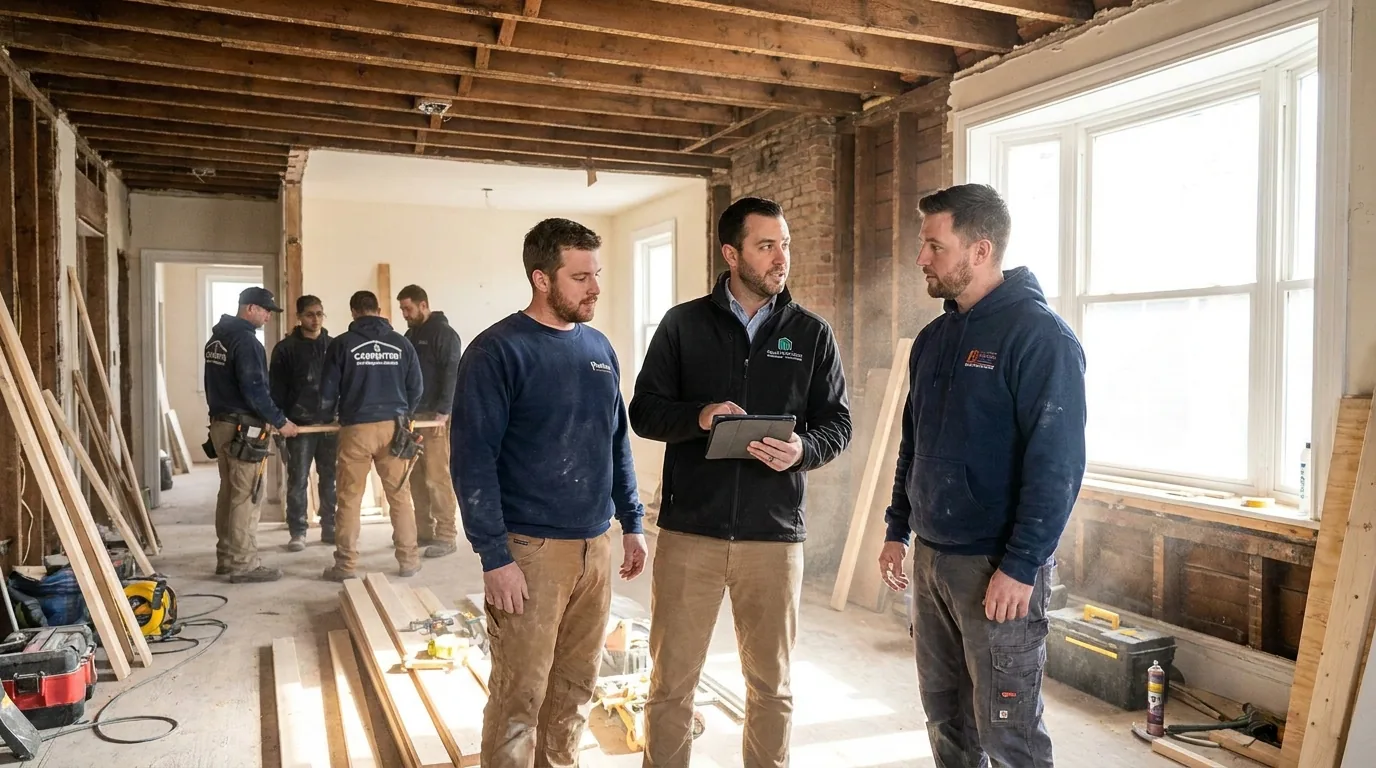
Most homeowners don't ask the question, but it's one of the biggest factors in how a renovation actually goes: are the people doing the work employees of the contractor, or are they subcontractors hired job-by-job?
The two models look identical on a brochure. They produce very different results in the field. After 20 years running renovations across Ottawa, I can usually tell within the first week of a project which model the other contractor on the street is using, just by watching the parade of trucks that show up.
Here's how the two models actually work, what each one means for cost, quality, and accountability, and the question to ask before you sign.
The subcontracted model
In the subcontracted model, the renovation contractor is essentially a project manager with a sales role. They sign the contract with you, then hire framers, electricians, plumbers, drywallers, tilers, painters, and cabinet installers as separate businesses, each on a per-job basis.
The contractor's full-time staff might be just the owner, an estimator, and maybe a project manager. Everyone touching the actual house is a subcontractor invoiced separately. The contractor's cut is the spread between what they charge you and what they pay the subs.
This is the dominant model in Ottawa renovation, and it has real advantages. Lower overhead means the contractor can quote sharper. They can flex up and down depending on workload (busy summer? hire more subs; slow winter? use fewer). They can match specialists to specialists (the cabinet sub who's done 200 kitchens versus a generalist who's done 20).
The downside: every sub is running their own business, with their own schedule, their own deadlines, their own incentives. The contractor's job is to make all those independent businesses arrive in the right order, do their work cleanly, and leave space for the next sub. Anyone who's run a project knows this is harder than it sounds.
The coordination cost nobody mentions
Here's the real cost of the subcontracted model: handoffs. Every time one trade finishes and another starts, there's a coordination cost. The framer leaves a wall plumb, the drywaller arrives, the wall is now hidden, the electrician shows up next week to find the boxes are in the wrong place because the framer didn't see the electrical plan.
On a clean subcontracted project with a well-organized contractor, handoffs cost a day each. On a typical one, two to three days. On a poorly run one, a week per trade. Multiply that by 8 trade transitions on a kitchen renovation, and you can lose 6 to 8 weeks to coordination friction alone.
The other handoff cost is finger-pointing. The tile sub blames the floor leveler the framer poured. The cabinet installer blames the drywaller for walls that aren't plumb. The contractor sits in the middle trying to assign blame and pay. Sometimes the homeowner ends up paying because everybody plausibly blames someone else.
The coordination test
Ask: "How many of the trades on my project are your employees, and how many are subcontracted?" Then ask: "Who's responsible for fixing it if the tile sub and the cabinet sub disagree about whose work caused the gap?" The answer tells you who actually owns the result.
The in-house model
In the in-house model, the contractor employs full-time tradespeople directly. Carpenters on payroll. A finish carpenter on payroll. Sometimes electricians and plumbers, though most contractors keep those subbed because of licensing. A cabinet shop with cabinet makers on payroll, in our case.
The overhead is higher. Payroll, WSIB premiums, vacation pay, vehicle costs, training, slow weeks paid the same as busy ones. A contractor running an in-house crew typically prices 8% to 15% higher than a fully-subbed competitor on the same scope.
What you get for that premium: the same people, every day, on every project. They know the contractor's standards because they hear them every morning at the toolbox talk. They've worked together for years. The cabinet maker knows what the finish carpenter needs. The framer leaves the rough opening exactly the way the window installer wants it because they were trained that way.
Quality control becomes a line management problem instead of a contract negotiation problem. If a cabinet door is hung crooked, the foreman walks over and tells the carpenter to fix it. There's no invoice, no debate, no escalation. It's just done.
At Dream Touch we run our own crew and our own in-house cabinet shop for exactly this reason. We sub the licensed trades (electrical, plumbing, gas) because the law requires us to, but everything else is staffed in-house. It's the reason our project schedules hit the dates we promise.
The WSIB and liability difference
This is the part most homeowners never think about, and it can land badly when something goes wrong.
WSIB (Workplace Safety and Insurance Board) is mandatory for Ontario employers. If a contractor's employee gets hurt on your property, WSIB pays the medical and lost-wage claims, and the contractor's coverage protects you from being sued personally. The contractor's WSIB clearance certificate proves coverage is current.
Subcontractors are a different story. A subcontractor is an independent business. They are responsible for their own WSIB. If they don't carry it, and one of their workers gets hurt on your property, the liability can chain back to you as the property owner.
This is why the WSIB clearance certificate question matters more on subcontracted projects. The general contractor can produce theirs, but they need to also produce one for every sub on the job. Most don't, and most homeowners don't ask. It only becomes an issue when somebody gets hurt.
The cheapest renovation quote almost always uses the loosest coordination structure. The price reflects what the contractor's risking, not what you're risking.
Quality control: the schedule tells the story
The quickest way to read which model a contractor is running is to ask for a project schedule with named workers. Not just "framing week 1, drywall week 2." Ask for the actual people who will be on site each week.
An in-house contractor can name them: "Mike and Sam are framing, Sam's doing the cabinet install in week 6, Marcus is on finish carpentry through closeout." A subbed contractor can't, because the sub assignments aren't locked until the week before. They'll say something like "we have great trades we work with regularly" and leave it at that.
"Trades we work with regularly" can mean anything from "the same five guys for 10 years" to "whoever's available that week." There's no way to tell from the outside. The schedule tells you.
Where the model actually shows up
The in-house vs subbed distinction shows up in three concrete places on every renovation:
- Daily start times. In-house crews start when the foreman says. Subbed crews start when their other job lets them. The 7am start time on the contract is real for in-house, aspirational for subbed.
- Punch list speed. The list of small fixes at the end of a project (a cabinet door tightened, a paint touch-up, a piece of trim re-cut) gets done in 2-3 days with an in-house crew because the carpenter is back on Monday. With subs, it can take 4-6 weeks because the sub is now on someone else's job and has to schedule a return visit.
- Warranty calls in year 1. A workmanship issue 8 months out gets handled in a week with an in-house crew. With a sub-heavy contractor, it depends on whether the sub is still in business and whether the contractor can convince them to come back for a small job.
What costs more, what costs less
On price alone, a fully-subbed contractor will almost always quote less than an in-house contractor on the same scope. Usually 8% to 15% less, sometimes more on simple projects where coordination cost is low.
On total project cost (contract price + change orders + delay costs + warranty hassles), the gap closes or reverses, depending on the contractor's actual coordination skill. A great subbed contractor with strong project management can deliver a clean job at a clean number. A weak one delivers a project that's nominally cheap and actually expensive.
An in-house contractor charges more upfront and protects you from the variance. Less coordination risk, faster handoffs, faster punch list, faster warranty response. The premium isn't free; it's buying you predictability.
The question to ask
Before you sign anything, ask the contractor straight up: "Of the trades that will be on my project, how many are your employees on payroll, how many are regular subs you've used for years, and how many will be sourced specifically for my project?"
The honest answer might be 60/30/10 or 30/60/10 or 100/0/0. None of those answers is automatically wrong. What matters is that the contractor knows the answer, can explain it, and that it matches the price they're charging. A high in-house ratio at a sub-level price is suspicious. A fully-subbed structure at a premium price is suspicious in the other direction.
If you want to see what an in-house Ottawa renovation crew looks like in practice, we run open shop tours by appointment. Ten minutes in our cabinet shop tells you more than ten brochures.