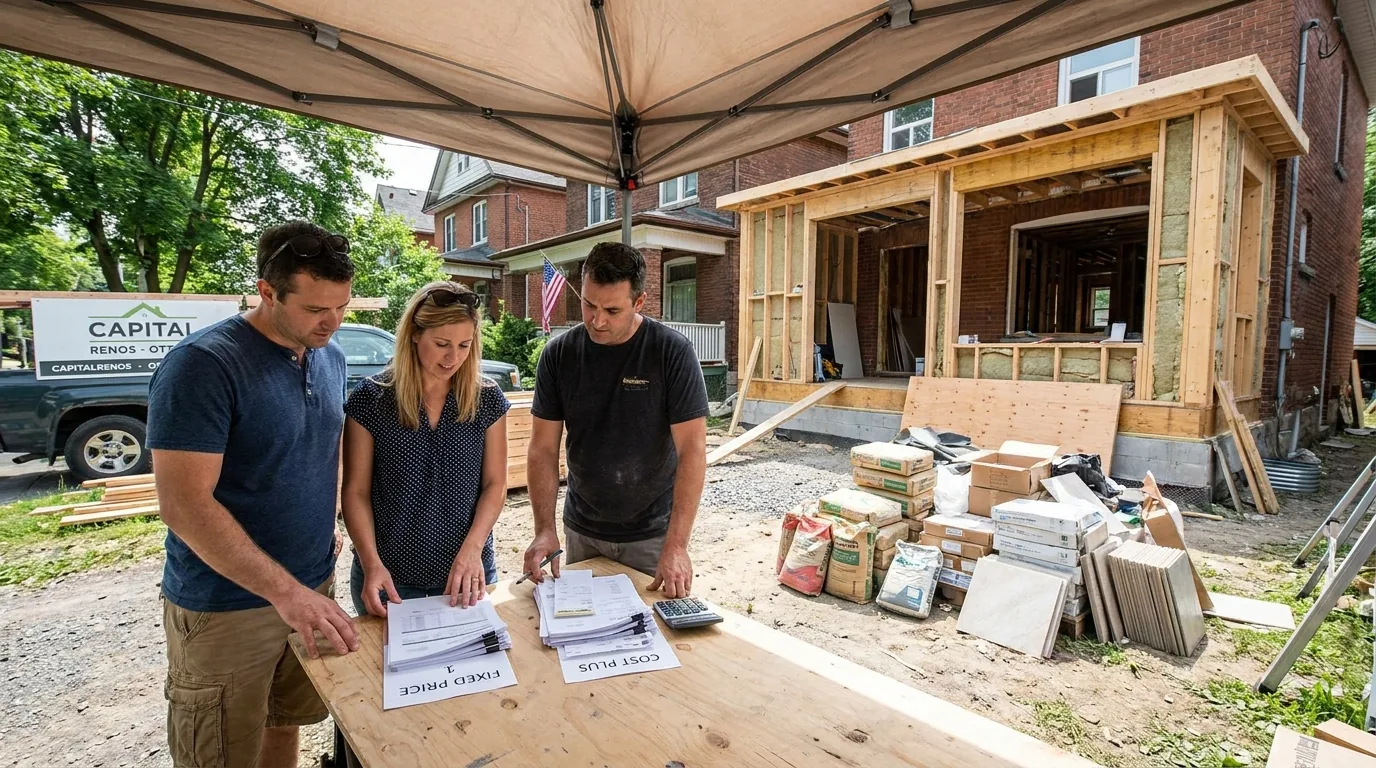
A homeowner in Alta Vista signed a cost-plus contract last summer thinking she was being smart. Open scope, partial design, big addition. The total ran well past where the fixed-price quote we'd put together for her would have landed. She paid a real premium to "have the flexibility."
Two months later, an old client in Stittsville signed a fixed-price contract for a basement legalization. Mid-project, the framers found a 1970s mid-pour footing that wasn't on any drawing. It cost us real money to address. He paid the contracted number; we ate it. Fixed-price worked exactly the way it was supposed to.
These two stories are why this conversation matters. Fixed-price isn't always better. Cost-plus isn't always worse. The right answer depends on whether your scope is actually defined yet.
What "fixed-price" really means
A fixed-price contract names a single dollar number for a defined scope of work. If the contractor's estimate was wrong, that's their problem, not yours. Surprises in walls? On them. Lumber prices spike mid-project? On them. The job runs three weeks long? Their schedule risk.
The trade-off is that fixed-price requires defined scope. Every cabinet brand, every fixture, every finish, every layout decision needs to be locked before signing. If those aren't locked, the contractor can't give you a real number; they're guessing.
Most "fixed-price" contracts in Ottawa aren't actually fixed because the scope isn't actually defined. There are vague allowances, "as-required" lines, and "to-be-selected" finishes scattered through the document. Each one is a future change order in disguise.
What "cost-plus" really means
Cost-plus is exactly what it sounds like: you pay the actual cost of materials and subs, plus a contractor's fee. The fee is either a percentage (typically 15% to 25% in Ottawa) or a fixed management fee.
The pitch is transparency. You see every receipt. You know exactly what the lumber cost, what the electrician charged. The contractor's incentive is clean: more accurate ordering means less waste, but they don't profit by inflating numbers.
The reality: total cost is unknown until the project is done. The contract has a budget estimate, but no ceiling unless you specifically negotiate one. If lumber rises, if a wall surprise forces a redesign, if an inspector requires an upgrade, you pay for all of it plus the percentage.
When fixed-price works (and when it backfires)
Fixed-price is the right structure when:
- Scope is defined: complete drawings, finalized selections, every fixture model number on the page
- The work is predictable: a kitchen in a 2010-built Kanata home with a known floor plan, no structural surprises likely
- You want budget certainty: you've stretched financing, you can't absorb a 20% overrun
- You don't want to be the project manager: you want one number, one date, one accountable party
Fixed-price backfires when the scope is fake. If the contractor priced "kitchen renovation" without selections finalized, the contract is a guess in formal clothing. Every selection you make later that's slightly above the assumed allowance becomes a change. By month three, you're in a cost-plus job with the paperwork of a fixed-price one.
When cost-plus works (and when it doesn't)
Cost-plus is the right structure when:
- Scope can't be defined yet: a 1920s Civic Hospital area home where everyone knows there's plaster, knob-and-tube, and unknown wall conditions, but nobody knows how much
- You're doing structural surprises: a deep dig basement, a foundation underpinning, a major addition into questionable soil
- The design is still evolving: you and the BCIN designer are iterating, you want to start while later phases are still being drawn
- You have margin for variance: your budget can absorb a 15% to 25% swing without breaking the project
Cost-plus fails when the homeowner doesn't actually want to manage decisions. If you can't make 30 product selections in three weeks, cost-plus stalls. It also fails when the contractor's tracking is sloppy. You're trusting them with every receipt. If receipts are vague, the trust breaks fast.
The hybrid most Ottawa homeowners actually want
Most successful Ottawa renovations use a hybrid: fixed-price for the defined parts (cabinets, counters, finishes) and a smaller cost-plus or allowance pool for the unknowns (structural, mechanical surprises, soil conditions). The contract names a maximum spend, with detailed reconciliation at the end. We build most of our addition contracts this way.
A side-by-side comparison
Here's the same Westboro kitchen renovation structured both ways. Defined scope, partial design. What each contract actually contains:
Fixed-price structure
- One contracted number for the whole defined scope
- Allowances clearly named for tile, lighting, and hardware so finish choices are transparent
- Contingency held by the contractor, not the homeowner
- Schedule: 12 to 14 weeks
- The final landed close to the contract, with one homeowner-driven change for a wine fridge
Cost-plus structure, same project
- An open-book base plus a management fee percentage
- Materials billed open-book at supplier cost
- A budget estimate rather than a contracted ceiling
- Schedule: 12 to 16 weeks (looser, by design)
- Final total depends on the selections you make along the way
For this project, fixed-price came out ahead. Why? Because the scope was actually definable. The kitchen is in a 2008 home, no structural surprises, the homeowner had selections done.
Now flip it. Same homeowner, but for a basement legalization in a 1958 Civic Hospital area home with bowing walls and a partial dig. Here cost-plus would likely come out lower, because fixed-price would have to bake in worst-case contingency. The unknown scope makes cost-plus the cheaper bet.
Risk allocation: who pays for surprises?
Every renovation has surprises. The contract decides who pays for them.
Under fixed-price, surprises that fall within scope are the contractor's problem. Surprises outside scope (a hidden pipe needing a re-route, a structural condition not visible during the site visit) become a change order. The contractor has to prove the surprise was outside the original scope, which is why scope clarity matters so much.
Under cost-plus, the homeowner pays for every surprise plus the markup percentage. There's no defense against bad luck. The flip side is the contractor has no incentive to "win" the surprise argument, because there's no upside in inflating it.
Fixed-price pays for the contractor's risk. Cost-plus pays for your own.
The contract clause that fixes most of this
Whether you go fixed-price or cost-plus, one clause solves 80% of the future arguments: a guaranteed maximum price, often called a GMP.
A GMP says "the project will not exceed a named ceiling regardless of overruns." Cost-plus with a GMP gives you the open-book transparency you wanted, plus a ceiling. If costs come in below the GMP, you save the difference (sometimes split with the contractor, sometimes returned 100%). If they exceed the GMP, the contractor eats it.
GMP contracts cost a few percent more than pure cost-plus because the contractor is accepting tail risk. They cost less than fixed-price because the contingency is shared, not buried. For most large Ottawa projects, a GMP cost-plus is the cleanest structure.
How to decide for your project
Three questions:
- Is the design complete? If yes, fixed-price probably wins. If no, you can't honestly fixed-price what isn't drawn yet.
- Are there structural unknowns? If your home is pre-1965 or you're touching foundations, cost-plus or GMP usually wins.
- What's your tolerance for surprise? If a 15% overrun would break your financing, fixed-price is the safer bet even if it costs slightly more on average.
We do roughly 80% of our Ottawa work as fixed-price because we insist on completing design before pricing. For the 20% of jobs where the scope can't be honestly defined upfront, we use GMP cost-plus. We don't do open-ended cost-plus contracts; we've watched too many of those balloon for our clients.
If you want to see whether your project should be priced fixed or cost-plus, our team will look at your scope and tell you honestly which structure fits. Walk us through what you're planning and we'll tell you what we'd sign if it were our own house.
The contract structure is the second most important decision you make on a renovation. The first is who you sign with.
Frequently asked questions
What is a fixed-price renovation contract?
A fixed-price contract names a single number for a defined scope of work, and the contractor carries the risk if the estimate was wrong: surprises within scope, mid-project material price spikes and schedule overruns are the contractor's problem. The trade-off is that every cabinet, fixture, finish and layout decision must be locked before signing. Vague allowances and to-be-selected finishes become change orders later.
How does a cost-plus renovation contract work?
Under a cost-plus contract the homeowner pays the actual cost of materials and subcontractors plus a contractor's fee, either a percentage, typically 15% to 25% in Ottawa, or a fixed management fee. Every receipt is visible. The total is unknown until the project ends, and there is no ceiling unless one is negotiated, so the homeowner pays for every surprise plus the percentage.
When is cost-plus the better choice for a renovation?
Cost-plus fits when the scope cannot be defined yet: a 1920s home with plaster, knob-and-tube and unknown wall conditions, a deep dig basement, underpinning, a major addition into questionable soil, or a design still evolving. The budget also needs room to absorb a 15% to 25% swing. Cost-plus stalls if the homeowner cannot make decisions quickly, and fails if the contractor's receipt tracking is sloppy.
What is a guaranteed maximum price contract?
A guaranteed maximum price, or GMP, sets a ceiling the project will not exceed regardless of overruns. Cost-plus with a GMP keeps open-book transparency and adds that ceiling. If costs come in under the GMP, the homeowner keeps the difference, sometimes split with the contractor; if they go over, the contractor absorbs it. A GMP clause settles about 80% of future arguments, whichever contract type is used.
How do I decide between fixed-price and cost-plus?
Three questions decide it. Is the design complete? If yes, fixed-price usually wins, since what is not drawn cannot be honestly fixed-priced. Are there structural unknowns, such as a pre-1965 home or foundation work? Then cost-plus or a GMP usually wins. Would a 15% overrun break the financing? If so, fixed-price is the safer bet. Many projects use a hybrid of both.