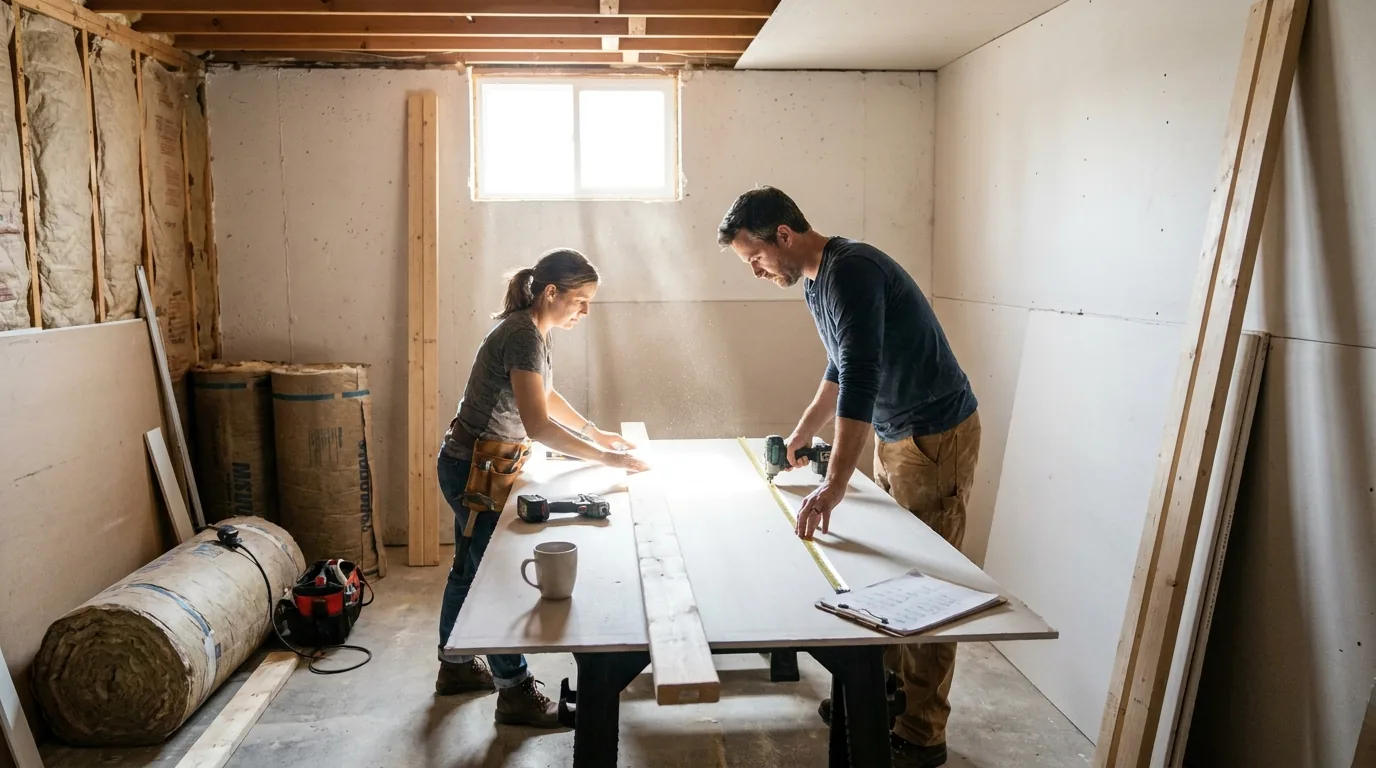
Every Ottawa homeowner who finishes a basement themselves tells the same story afterward. They saved a lot of money. They also lost six months of weekends, two arguments with their spouse, and one or two specific subtrades they thought they could handle.
The end result is usually 80% as nice as a contractor would have built and cost 40% as much.
That trade is real. For a lot of people it is the right call. But the version of the story DIYers tell on Reddit underplays what you actually take on. Here is the honest accounting.
What drives the price of a finished Ottawa basement
For a 700 to 1,000 square foot basement with one full bathroom, a wet bar, an open rec room, and a small office or guest bedroom, a fixed-price contractor builds the quote from the scope, the finish level, and the site conditions rather than a flat per-foot rate. Every line below is a cost driver you can dial up or down.
The scope that goes into the proposal:
- Permits, drawings, BCIN review
- Demolition and prep
- Framing, insulation, vapour barrier
- Electrical (rough-in, fixtures, panel work)
- Plumbing (rough-in for bath and bar)
- HVAC modifications
- Drywall, mudding, priming, painting
- Bathroom finishes (fixtures, tile, vanity, glass) — the single biggest swing, driven by your material selections
- Flooring (LVP or laminate)
- Trim, doors, hardware
- Cabinetry (wet bar)
- Lighting, finishings, miscellaneous
- Contractor margin (overhead, supervision, warranty): the markup that keeps the company alive
The bathroom finishes and cabinetry carry the most variability, because that is where material allowances move. A clear, itemized proposal lets you see each driver and adjust the scope before anything is built.
What a DIY basement actually saves
The honest savings on a true DIY basement, where you do everything that the law allows you to do and hire out only what you must, run 35% to 50% off the contractor price.
The savings come from labour, not materials. The materials cost about the same whether you or a crew install them. Lumber from Castle, drywall from Home Depot, fixtures from Plumbing Mart Ottawa: those numbers don't move.
What you save is the labour the contractor would charge for. On a contractor-built basement, the carpentry, drywall, finishing, and painting labour is roughly half the total. If you do that work yourself, you save that money. The materials, sub-trades, permits, and finishes still cost what they cost.
That is why a true DIY basement lands well below the contractor price for the same scope: you are removing the labour line, not the materials or the licensed sub-trades.
Safety warning: in Ontario, you cannot DIY everything in a basement
Three trades in an Ottawa basement renovation are restricted by law. Electrical work requires either a licensed electrical contractor or a homeowner permit through ESA, and only the homeowner residing in the home can do it themselves under the homeowner permit. Plumbing requires either a licensed plumber or homeowner work that's inspected by the City.
Gas work is TSSA-licensed only, no homeowner exemption. Doing electrical or plumbing without a permit voids your home insurance, fails at resale inspection, and can be ordered torn out at your expense. The permit and inspection fees to do it right are modest, and far cheaper than the lawyer you'll need if you skip them.
What you can DIY, what you should hire out, and what's restricted by law
Tasks that homeowners typically handle well
- Demolition and prep (removing old finishes, framing, drywall)
- Wood framing of interior walls (with permitted plans)
- Insulation installation (batt or rigid foam, plus vapour barrier)
- Drywall hanging (the carpentry part)
- Painting
- Trim and baseboard installation
- Door hanging
- Click-lock flooring (LVP or laminate)
- Bathroom tile (with patience and the right tools)
Tasks where DIY is usually a mistake
- Drywall mudding and finishing. Hanging drywall is easy. Mudding it to a Level 4 finish that paints flat takes a skilled finisher. DIY mud jobs almost always need a coat of skim plaster from a pro to fix. A drywall taper is one of the best-value sub-trades to hire out, priced by the square footage of finished wall and ceiling.
- Shower waterproofing. Schluter Kerdi or Wedi systems are DIY-installable but unforgiving. One missed corner detail and the wall behind the shower rots in 5 years. If you've never done it, hire a tile setter for the shower walls only.
- HVAC modifications. Adding registers, extending ducts, modifying the cold air return for the new layout. The math (CFM per room, return path) is not obvious and getting it wrong creates dead rooms.
Tasks restricted by law
- Electrical work. Either a licensed electrical contractor or a permitted homeowner doing the work themselves. No exceptions for "a friend who's an electrician."
- Plumbing changes. Permitted by the City of Ottawa. Homeowner work allowed but inspected.
- Gas connections. TSSA-licensed gas fitter, no exception.
The time DIY actually takes
The contractor finishes a typical Ottawa basement in 8 to 12 weeks of working time, with a crew of 4 to 6 trades flowing through.
The DIY homeowner working evenings and weekends finishes the same basement in 6 to 10 months. Sometimes more. The math is straightforward: you have one person (maybe two on weekends), and you can only do one thing at a time. The contractor has framers, drywallers, an electrician, a plumber, a tile setter, and a painter, and three of them might be on site the same day.
The 8 to 10 month DIY timeline assumes:
- You actually work on it most weekends
- You don't get sick, lose a job, have a kid, or hit a hard week at work
- You can wait for sub-trades (the licensed plumber's earliest opening is often 3 to 6 weeks out, and you can't do anything else until they're done)
- Your spouse is genuinely on board for the duration
The two-bedroom basement that takes a contractor 10 weeks takes a DIYer 10 months. Multiply that by 40 weekends spent in the basement instead of with family or doing what you'd normally do on a Saturday.
Where DIY budgets actually blow up
Three categories where DIY basement projects routinely overspend:
Tools you didn't think you needed
The lift to hang ceiling drywall (rented, usually twice). The miter saw stand. The pneumatic brad nailer (rented or bought). The laser level. The hammer drill for Tapcons into the slab. The shop vac. The bigger ladder. The longer extension cord. The tool and rental spending stacks up into a real line item most DIYers don't budget for.
The "while we're at it" expansions
You demo the wall, find old wiring that's not to code, and decide to replace it. You open the ceiling, find a pinhole leak in a copper pipe, and have to replumb a section. You expose insulation that's been there since 1978 and decide to upgrade. Each "while we're at it" adds another chunk to the budget, and three of them in a basement is normal.
The redo
The wall that wasn't quite plumb. The corner of drywall that needs more mud. The floor stain that was the wrong colour. The light fixture that doesn't match anything else. Most DIY basements carry a meaningful redo cost in wasted materials and re-bought finishes that wouldn't happen with a pro.
The DIY basement isn't as much cheaper as the headline savings suggest. Once you net out the tools, the redos, and the sub-trade reschedules, the real gap narrows, and it took several more months to get there.
The honest call
DIY basement finishing makes sense if:
- You enjoy the work and the project. If the work is the reward, the time investment becomes a feature, not a cost.
- You have realistic carpentry, drywall, and finish skills, OR you're willing to learn and accept the redo costs.
- You have 6 to 10 months of weekends available with no major life disruptions on the horizon.
- Your scope is moderate (not three-bedroom secondary suite with full kitchen).
- You're willing to hire out the sub-trades that need it (drywall finishing, shower waterproofing, electrical, plumbing).
It does not make sense if:
- You're doing a legal secondary suite (the code requirements are strict and the inspections are unforgiving)
- The basement has unresolved water issues
- You're trying to maximize resale value (a well-executed contractor finish reads better at sale than an obvious DIY job)
- You don't have realistic free time
For Ottawa basements that need to be done right the first time, legal secondary suites, basements where ceiling height is tight and the layout matters, basements with rough-in for plumbing that needs to be relocated, the contractor route gives you a 1-year DTR warranty plus the manufacturer's warranties on every component. For more on the contracted route, see our basement renovation Ottawa page.
Frequently asked questions
How much can I save by finishing my basement myself?
A true DIY basement, where the homeowner does everything the law allows and hires out only what is required, typically saves 35% to 50% off the contractor price. The savings come from labour, not materials, since lumber, drywall and fixtures cost about the same whoever installs them. Carpentry, drywall, finishing and painting labour make up roughly half of a contractor-built basement. Tools, redos and expansions narrow the gap.
Which basement work does Ontario law restrict from DIY?
Three basement trades are restricted by law in Ontario. Electrical work needs a licensed electrical contractor or a homeowner permit through the ESA, and only a homeowner living in the house can use that permit. Plumbing needs a licensed plumber or homeowner work inspected by the City. Gas work is TSSA-licensed only, with no homeowner exemption. Unpermitted electrical or plumbing can void insurance and be ordered torn out.
How long does it take to finish a basement yourself?
A homeowner working evenings and weekends usually takes 6 to 10 months to finish a basement, sometimes longer. A contractor finishes a typical Ottawa basement in 8 to 12 weeks, with 4 to 6 trades flowing through and several on site the same day. The DIY timeline assumes steady weekends, no major life disruptions, and waiting 3 to 6 weeks for the first opening of a licensed plumber.
Which basement tasks should a DIYer hire out?
Drywall mudding and finishing, shower waterproofing and HVAC changes are the basement tasks DIYers most often get wrong. Hanging drywall is easy, but a Level 4 finish that paints flat takes a skilled taper. One missed corner in a Schluter Kerdi or Wedi shower can rot the wall in 5 years. Extending ducts and returns needs CFM-per-room math, and getting it wrong leaves dead rooms.
When does a DIY basement not make sense?
A DIY basement does not make sense for a legal secondary suite, where the code requirements are strict and inspections unforgiving. It also does not suit a basement with unresolved water issues, a project aimed at maximizing resale value, or a homeowner without realistic free time. DIY works best for a moderate scope, with 6 to 10 months of weekends available and a willingness to hire out the restricted trades.
Official references
- Do I need a building permit?, City of Ottawa