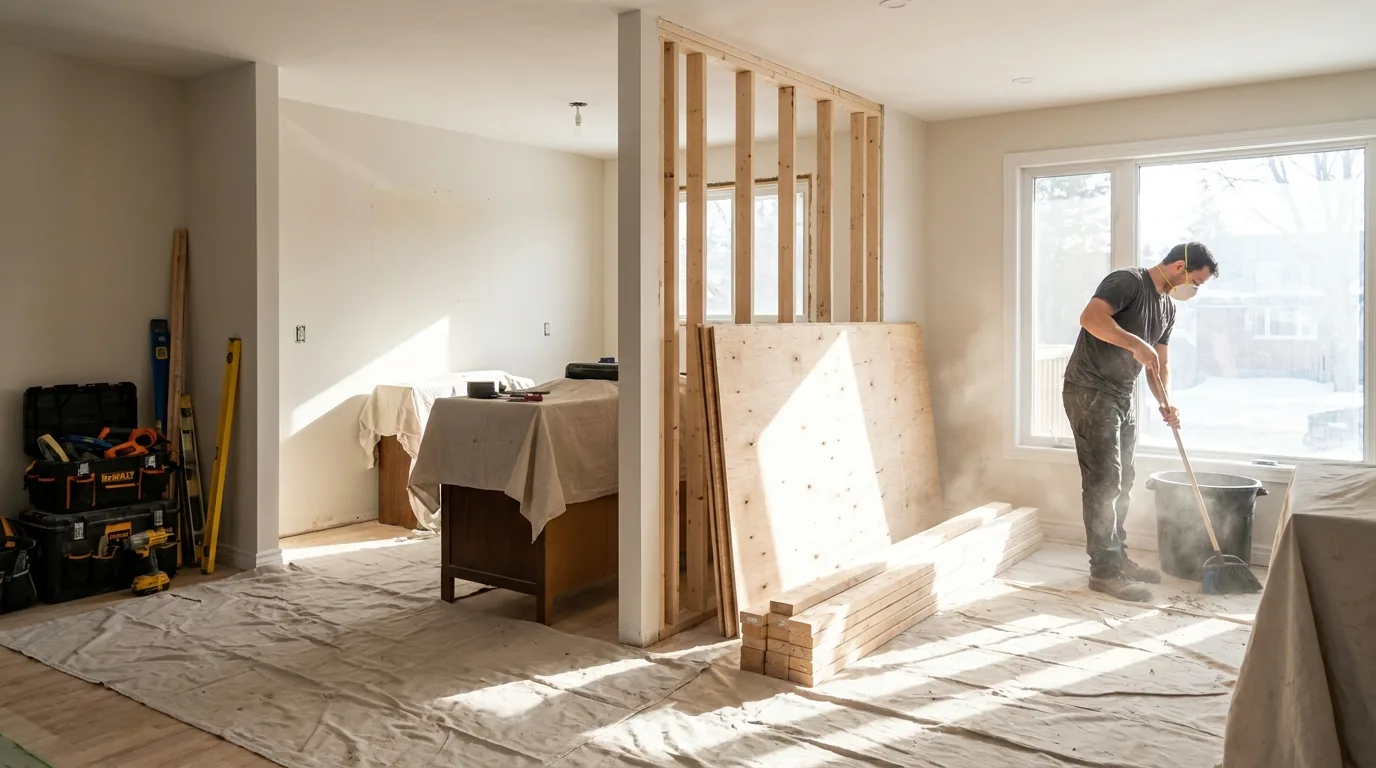
Walk onto any active renovation site in Ottawa and you can predict the final quality in about 90 seconds. Not by looking at the trim or the cabinet boxes. By looking at the floor.
I had a homeowner in Westboro call me three years ago to take over a stalled second-storey addition. The previous contractor had walked off the job at week 11. Before I even looked at the framing, I walked the site.
The subfloor was buried in scraps of OSB, dried mud, snapped Tapcons, three coffee cups, two pop bottles, and a pile of damp insulation that had been sitting under a window leak for at least two weeks. The framing turned out to be exactly as bad as the floor.
Site cleanliness is not a courtesy. It's a quality signal. It tells you, in real time, what kind of work is going to come out of that crew when you can't see it.
Cleanliness is a leading indicator
Every renovation has roughly 4,000 small decisions that nobody writes down. Did you blow the dust out of the receptacle box before terminating the wires? Did you wipe the pipe before the solder? Did you vacuum the kerf before glueing the joint? Did you sweep the tile bed before you set the field?
The crew that doesn't keep the floor swept doesn't do those small things either. The crew that does keep it swept usually does. That's not folklore. It's how habit transfer works on a job site.
If you spend an afternoon on an active site and the floor is clean enough that you'd let your kid sit on it, the framing nailing pattern is also clean. If the floor is a hazard, the nailing pattern is a hazard too. Whether you've ever heard the words "nailing pattern" is beside the point. The contractor's standard is what it is on every detail at once.
Dust control is the first cleanliness test
Dust is the cheapest signal to read. Walk into the homeowner's kitchen during demo of an upstairs bathroom. Run a finger across the kitchen counter. The amount of dust you find is in direct proportion to the contractor's care.
What dust control actually looks like in an Ottawa renovation:
- HEPA-filtered shop vacs attached at the source whenever a saw is running. Track saws, mitre saws, and concrete grinders all have dust ports for a reason.
- Zip walls with zippered doorways that stay closed when nobody is moving through them, not held open with a chunk of two-by-four.
- Return-air vents sealed in the work zone for the entire duration of the project, not just the first day.
- Negative-air machines running during dust-heavy work (drywall sanding, demo, concrete cutting) and exhausting outside.
- Tack mats at every exit point from the work zone, so dust on boots stays in the work zone.
If you walk into the rest of the house during demo week and there's drywall dust on the dining table or in the master bedroom, the dust control failed. It usually means a zip wall isn't sealed at the top, a return vent wasn't covered, or a crew member is propping the zipper open.
The dust check at six weeks
Six weeks into a project, run a white napkin across the top edge of a doorway in a room two floors away from the work zone. If the napkin comes back grey, the dust control isn't working and the contractor either doesn't know or doesn't care. Both answers are equally bad.
End-of-day cleanup is non-negotiable
The end-of-day cleanup is one of the cheapest tells in renovation. Crews who clean up at 4:30 deliver clean projects. Crews who race to a 5pm finish and leave the site looking like a tornado deliver projects that look like tornadoes.
What the end-of-day cleanup should include:
- Debris removed from the work zone and dumped in the dumpster, not piled in a corner for tomorrow.
- Floor swept with a broom, then vacuumed with a HEPA shop vac. Two passes minimum.
- Tools either packed back into the truck or stacked in a designated tool zone, not scattered across the floor.
- Cords coiled and hung on a nail or hook, not snaked across the floor.
- Floor protection re-taped where it lifted during the day.
- Driveway swept if the dumpster sits there. The neighbours notice this even if the homeowner doesn't.
- Negative-air machine left running on low overnight in extended-duration projects.
This takes 30 to 45 minutes a day. The contractor priced it into the bid (or should have). When the cleanup is skipped, the crew is borrowing time from your warranty period, your neighbour relationships, and your sanity.
Tool storage is character
Watch where the crew puts their tools when they break for lunch. Tools laid neatly along a wall, blades guarded, cords coiled, batteries on chargers? You're looking at a crew that respects the work. Tools dropped where they were last used, blades exposed, cords pooled on the floor? You're looking at a crew that respects nothing.
The lunch-break test is one of my favourite cleanliness reads because it happens in the middle of the day. The crew is not putting on a show for the homeowner. They're just being themselves for 30 minutes, and what they do with their tools tells you what they do with your house.
You can fake clean for 90 minutes during a homeowner walkthrough. You can't fake clean for 12 weeks. The site at week 8, when nobody's looking, is the real one.
The dumpster is a public document
The dumpster on the driveway is a public document. Anyone walking the street can read it. Yours, the neighbours', the city bylaw officer if they happen by.
What a well-run dumpster looks like: filled in layers, heavy stuff on the bottom (concrete, plaster, cabinet boxes), light stuff on top (insulation, drywall offcuts), no overflow, tarp pulled across the top at end of day to prevent debris blowing into the neighbour's yard. The lid stays closed. No paint cans, no propane tanks, no household trash from the homeowner's bin getting tossed in by accident.
What a badly-run dumpster looks like: overflowing by week 2, debris on the boulevard, a cabinet door sticking out at a 45 degree angle, a half-can of stain leaking down the side. The City of Ottawa can issue a fine for an overflowing dumpster on the public right-of-way. The contractor who lets that happen is the contractor whose bills don't get paid on time either.
Cleanliness is what you're actually paying for
Here's the part nobody puts on a quote line. When you hire a contractor, you're not really paying for nails and lumber. The materials are 35 to 45% of the bid. You're paying for the management of about 12 trades, 80 deliveries, 600 small decisions, and the one factor that determines whether all of that goes well: standards.
The contractor's cleanliness standard is the visible proxy for everything else they care about. The crew that vacuums before they bed tile is the crew whose tile is still flat in 10 years. The crew that doesn't vacuum gets a hollow void under the tile, the void cracks the grout, the grout lets in moisture, and you have a callback in year 3.
You don't see the void. You see the floor. But the crew that creates the void is the same crew that leaves coffee cups on it.
What to do during your walkthroughs
If you've already hired a contractor and want to read the site, walk it on a Tuesday afternoon at 2pm without warning, two or three times across the project. Don't announce. Just stop by.
Walk in a straight line from the entry to the work zone. Note: how clean is the path? Is the floor protection intact? Are there gaps? Is the zip wall sealed? Are tools racked or scattered? Is the dumpster lid closed? Is there food trash anywhere? Is there water on the basement floor anywhere? Are extension cords coiled or strewn?
If three out of four of those answers are good, you have a clean contractor. If three out of four are bad, you have a problem that's going to surface at the punch list and again at year 1 of warranty. The cleanliness pattern is the durability pattern, every time.
This is one of the reasons we keep our entire process in-house, including the cabinet shop and the framing crew. Standards travel sideways through people who work together every day. They don't travel through subcontractors hired job-by-job.
If you want to see what a clean Ottawa renovation site actually looks like, book a tour of any of our active projects. It's the fastest way to set the bar before you sign with anyone.
Frequently asked questions
What does good dust control look like during a renovation?
Good renovation dust control starts with HEPA-filtered shop vacs attached at the source whenever a saw runs. Zip walls should keep their zippered doorways closed, return-air vents in the work zone stay sealed for the whole project, and negative-air machines run during drywall sanding, demolition and concrete cutting, exhausting outside. Tack mats at every exit keep dust on boots inside the work zone.
How can I tell if my contractor's dust control is working?
Six weeks into a renovation, run a white napkin across the top edge of a doorway in a room two floors away from the work zone. A grey napkin means dust control is failing. Drywall dust on the dining table or in a bedroom during demolition week usually points to a zip wall not sealed at the top, an uncovered return vent, or a propped-open zipper.
What should a contractor's end-of-day cleanup include?
An end-of-day cleanup takes 30 to 45 minutes. Debris goes into the dumpster, not a corner. The floor gets swept, then vacuumed with a HEPA shop vac, two passes minimum. Tools are packed or stacked in a set zone, cords are coiled and hung, lifted floor protection is re-taped, and the driveway is swept if the dumpster sits there.
What does a well-run renovation dumpster look like?
A well-run renovation dumpster is filled in layers, with heavy material like concrete, plaster and cabinet boxes on the bottom and insulation and drywall offcuts on top. Nothing overflows, and a tarp goes across the top at the end of each day so debris does not blow into neighbouring yards. Paint cans and propane tanks stay out. Ottawa can fine an overflowing dumpster on the public right-of-way.
When should I visit my renovation site to check on the crew?
Visit a renovation site unannounced on a weekday afternoon, around 2pm, two or three times across the project. Walk straight from the entry to the work zone and check whether the path is clean, floor protection is intact, the zip wall is sealed, tools are racked, the dumpster lid is closed, and cords are coiled. Watch where tools go during the lunch break, too.
Official references
- Keeping the Heat In, Natural Resources Canada