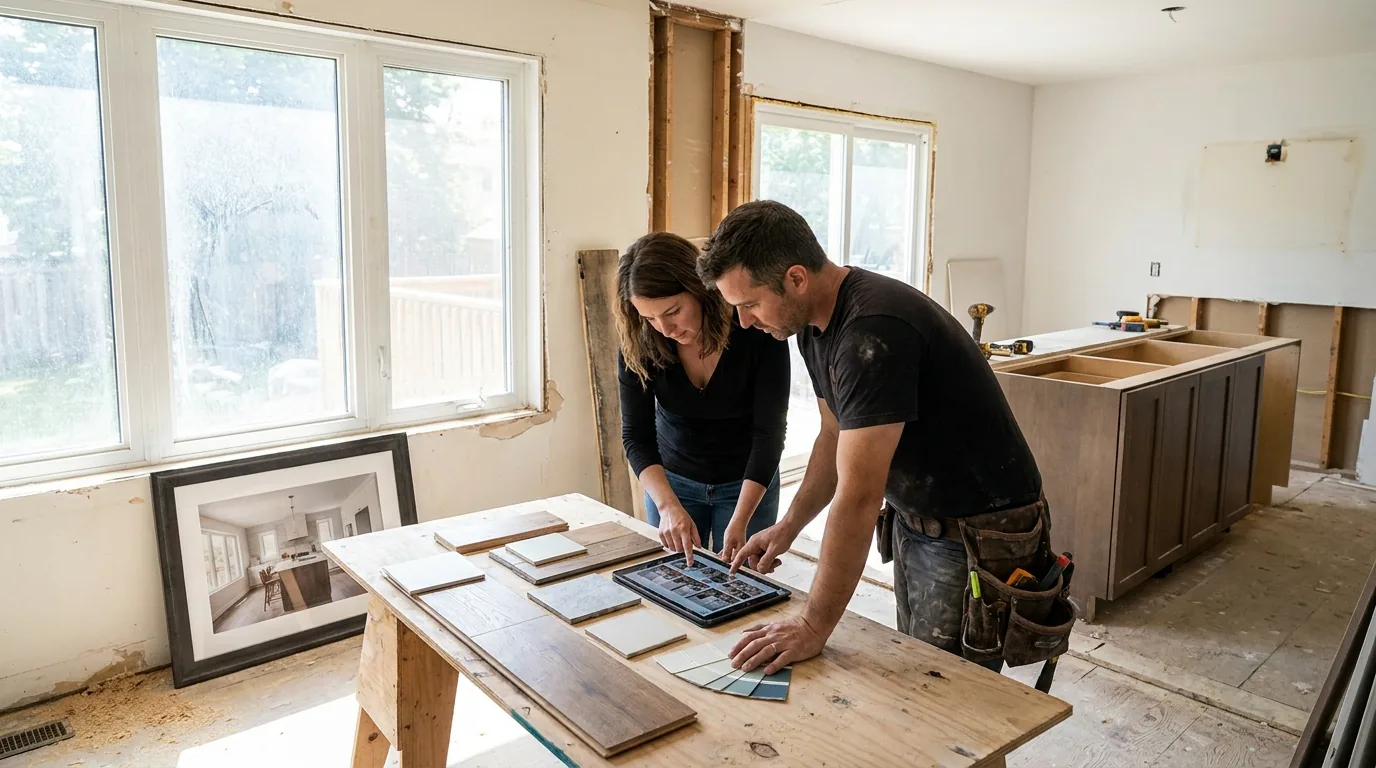
A homeowner in Manotick called me last fall after firing a contractor mid-project. She'd hired him off a website with 40 stunning kitchen photos. Beautiful work. Award-quality. The contractor she'd hired could not produce that work, and most of those photos were not his.
I asked where she found him. Google. Top of the local results. Pretty website. Five Google reviews, all four months old. She'd done what most people do: looked at the pictures, liked them, called.
Portfolio fraud in the renovation industry is more common than it should be. Some contractors lift photos from supplier catalogues. Some scrape competitors' Instagram. Some run their entire image library off Pinterest. The Better Business Bureau and the Ontario consumer protection authorities can do little about it because there's no licensing body verifying what shows up on a website.
Here's how to tell whether the photos you're looking at were actually built by the contractor you're talking to.
Reverse image search before anything else
The fastest test takes 90 seconds. Right-click any portfolio photo on the contractor's website, save the image to your desktop, and run it through Google Images or TinEye reverse search.
If the photo shows up on a manufacturer's website, a stock photography site, an architectural design firm in Vancouver, or a competing contractor in another city, that's it. The portfolio is fabricated. Walk away.
What you'll usually find on a real Ottawa contractor's portfolio: the photos appear only on their own site, their Google Business profile, possibly an Instagram, and maybe a Houzz listing tied to the same company name. Nothing else. That's a healthy footprint.
Stock photos and lifted images leave fingerprints. The same kitchen renders show up on five renovation websites across Canada. The cabinet manufacturer's promotional shots appear in the portfolios of half the kitchen contractors in Ontario. Reverse search exposes all of it in two minutes.
Ask for the address
Once a photo passes the reverse-image test, ask the contractor for the street and neighbourhood of three of the projects you like. Not the homeowner's name. Not contact details. Just "what neighbourhood was this kitchen built in?"
A contractor who built the project will name it without hesitation. "That's a kitchen we did on Holland Avenue near Hintonburg in 2024." "That's a basement in Findlay Creek from last spring." "That bathroom is in a heritage place in Sandy Hill, finished in 2023."
A contractor who didn't build it will hedge. "We've done a lot of similar projects in the west end." "I'd have to check our records." "We don't share addresses for client privacy."
Privacy is a real concern, but the neighbourhood and the year are not private. Real contractors talk about projects by neighbourhood the way real teachers talk about classes by year. It's how the work is organized in their head.
The contractor who built it remembers the day the granite was templated. The one who lifted it can't tell you what month it was finished.
Drive by a finished project
For any contractor you're seriously considering, ask to drive by an exterior of a recent project. Not inside. Just the exterior. From the street.
If they did the work, they'll give you addresses without much fuss. We routinely send Ottawa clients to drive past a coach house we built in Kanata, an addition in Orleans, a side dormer in Westboro. The owners don't know. The work is visible from the street.
If the contractor pushes back hard on giving you a single drive-by address from a project completed 12+ months ago, the portfolio is suspect. There are very few legitimate reasons to refuse. Real homeowners are usually happy to have their finished house pointed at; the work is something they're proud of.
The "drive-by" workaround
Some contractors will offer to "ask the homeowner first" and never get back to you. If that happens, push once. If they still can't produce a drive-by within a week, treat the portfolio as unverified. A 6-month-old kitchen photo without a verifiable address is just a photo.
Look for project details, not project glamour
Real renovation portfolios contain ugly photos. Not exclusively, but they're in there. Mid-construction shots. Materials staged on a driveway. A trade worker installing a vapour barrier. A subfloor before tile.
Fabricated portfolios contain only finished, styled, magazine-quality shots. Every kitchen has fresh flowers. Every island has a wooden bowl of lemons. Every bathroom has a candle and a folded towel. The shots are too clean.
The reason is simple. Real contractors take photos with a phone at 4 p.m. on a Friday before clean-up. The lighting is mediocre, the staging is whatever the homeowner left out, and a section of trim is taped because a touch-up is happening Monday. That's what a real portfolio looks like.
Glamour shots aren't bad in themselves. Most legitimate contractors hire a photographer for a few signature projects per year. But a portfolio that's 100% glamour with no progress shots, no rough-in photos, no honest-Friday-afternoon images, is suspicious.
The references that actually mean something
Three live references on three recent projects. Phone numbers. Not email. Phone calls.
"Recent" means within the last 12 months. References from 5 years ago tell you about the contractor 5 years ago, which is not the same business. Crew turns over. Foremen change. Quality changes.
When you call, ask three things:
- What did the contractor do well?
- What did they screw up?
- Would you hire them again, and at what scope?
If every reference says "everything was perfect, no problems at all," they're either family or coached. Real renovations have at least one bump. The honest reference will say "the cabinet hardware took two weeks longer than expected, but they handled it" or "we had a permit issue and they fixed it." That's the texture of a real project.
Cross-check on independent platforms
Google Reviews, Houzz, HomeStars, BBB, Better Business profiles. The contractor's photos and project descriptions should be consistent across all of them. The same kitchen on their website should appear on their Instagram with the same project name and roughly the same date.
What's a red flag: photos that exist only on the website and nowhere else. No Instagram presence. No Google Business photos. No Houzz profile. A contractor doing real work in 2026 is documenting it on at least one external platform.
Conversely, an Instagram with thousands of followers and only stock-looking content is also suspect. Real Ottawa contractors post a mix: progress photos, timelapses, the occasional team shot, finished projects, and the occasional honest "we found knob-and-tube and here's what we did" post. That's a working business, not a marketing front.
The portfolio gap most homeowners miss
One thing most homeowners don't check: does the portfolio represent the scope you're hiring for?
A contractor with 30 stunning kitchen photos and zero basement photos has not done many basements. They might be great at kitchens. They might be learning on yours if you hire them for a basement.
The same is true for additions, sunrooms, attic conversions, accessibility work, and full-home gut jobs. Each scope has its own learning curve. A contractor who's done 50 kitchens and 2 additions will run your kitchen well and your addition imperfectly.
Match the contractor's portfolio depth to your specific project. If you're doing a coach house or an attic conversion, ask to see at least 3-4 examples of the same scope. If they don't have them, you're either hiring a generalist or a specialist who doesn't actually specialize in what you need.
What we publish, and why
Our portfolio page lists projects by neighbourhood, year, scope, and budget range. We include progress photos alongside finished shots. We name the cabinet wood, the tile, the countertop material. We tell you which homes are still owned by the original clients (most of them) and which we can drive past on a 30-minute Ottawa loop.
We do this because the question "is this real?" is the right question, and the answer should be obvious from the page itself. If you have to ask, the portfolio isn't transparent enough.
The 10-minute screen
Before you book a quote, run this on any contractor you're considering:
- Reverse image search 3-5 portfolio photos
- Check that the same photos appear on their Instagram or Google Business
- Verify the company name matches across the website, Google reviews, and HSST or HomeStars
- Read the most recent 5 Google reviews; look for specific project details, not generic praise
- Note whether they list neighbourhoods, years, and scopes alongside photos
If all five check out, the portfolio is probably real and you can move to the quote conversation. If two or more fail, find another contractor. Ottawa has dozens of legitimate renovators. There's no need to take a risk on one whose portfolio doesn't hold up to ten minutes of scrutiny.
Dream Touch publishes neighbourhood, year, and scope on every project in our renovation portfolio. Free 48-hour walkthrough at 613-862-4555.
Frequently asked questions
How can I check if a contractor's portfolio photos are real?
A reverse image search checks whether a contractor's portfolio photos are real in about 90 seconds. Save a portfolio photo and run it through Google Images or TinEye. If the same photo appears on a manufacturer's website, a stock photography site, a design firm in another city or a competing contractor's site, the portfolio is fabricated.
A real contractor's photos usually appear only on their own site, their Google Business profile, and possibly an Instagram or Houzz listing under the same name.
What should I ask a contractor about the projects in their portfolio?
Ask the contractor for the street and neighbourhood of three portfolio projects, and the year each was finished. Do not ask for the homeowner's name or contact details. A contractor who built the work will name it without hesitation, such as a kitchen near Hintonburg in 2024.
One who did not will hedge, claim the records need checking, or cite client privacy, even though a neighbourhood and a year are not private. Then ask for one exterior drive-by address of a project finished 12 or more months ago.
What do real contractor portfolio photos look like?
Real contractor portfolios include some unglamorous photos: mid-construction shots, materials staged on a driveway, a worker installing a vapour barrier, or a subfloor before tile. Fabricated portfolios show only styled, magazine-quality shots, with fresh flowers and a bowl of lemons on every island.
Most legitimate contractors hire a photographer for a few signature projects a year, so glamour shots alone are fine. A portfolio that is 100% glamour, with no progress or rough-in photos, is suspicious.
How should I check a renovation contractor's references?
Ask for three live references on three projects from the last 12 months, with phone numbers rather than email. References from five years ago describe a different business, because crews and foremen change. Ask each reference what the contractor did well, what went wrong, and whether they would hire the contractor again and at what scope.
If every reference says everything was perfect, they are likely family or coached. Real renovations have at least one bump.
Does a contractor's portfolio need to match my type of project?
A contractor's portfolio should show depth in the same scope you are hiring for. Thirty kitchen photos and no basement photos means the contractor has not done many basements and may learn on yours. Additions, sunrooms, attic conversions, accessibility work and full-home gut jobs each have their own learning curve.
For a coach house or an attic conversion, ask to see at least 3 to 4 examples of that same scope before signing anything.
Official references
- Do I need a building permit?, City of Ottawa