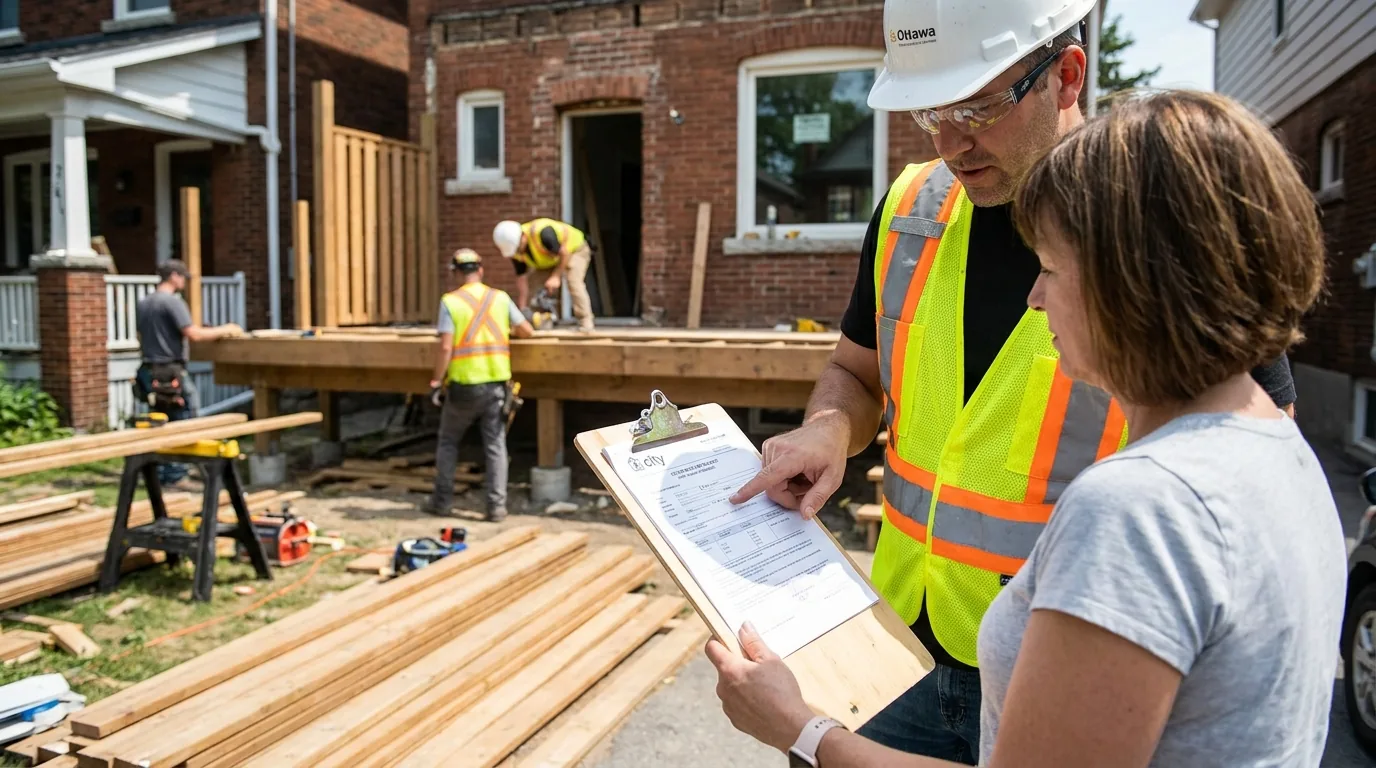
Ontario has no licence for general contractors or renovators. The Home Construction Regulatory Authority licenses builders and sellers of new homes, and says renovators are not licensed or regulated the way they are. What is licensed is the trade work: electricians, plumbers and gas fitters each need their own credential.
Asking a general contractor in Ottawa "are you licensed?" tells you little. You can run the checks below in an evening before you sign for an addition or a basement.
What is not licensed in Ontario
No provincial body licenses renovation contractors as a profession, and the City of Ottawa does not issue a contractor licence for renovation work. Anyone can register a business name and quote a job.
The one provincial builder licence, from the Home Construction Regulatory Authority (HCRA), covers new homes. Its guidance says renovating or upgrading an existing home does not make it new, so the renovator does not need an HCRA licence. A company building a new house for sale does.
The trades that are licensed
The general contractor needs no licence, but the people doing regulated work do. Three trades come up on almost every large renovation:
- Electrical work in your home can legally be hired out only to a Licensed Electrical Contractor, according to the Electrical Safety Authority. That contractor files the notification of work with ESA, and ESA inspects the wiring. Electrician, construction and maintenance (309A), and electrician, domestic and rural (309C), are compulsory trades too.
- Plumber (306A) is one of Ontario's 23 compulsory trades. A worker needs a Certificate of Qualification, a provisional certificate or a registered apprenticeship, under the Building Opportunities in the Skilled Trades Act, 2021.
- Work on gas lines and appliances is done by a gas technician certified by the Technical Standards and Safety Authority (TSSA), working for a TSSA-registered contractor.
Skilled Trades Ontario keeps a public register where you can look up a tradesperson's certificate by name.
Does a handyman need a licence?
"Handyman" is not a regulated title, so no. But the trade rules still apply to the work: a handyman who rewires a circuit or moves a drain is doing electrical or plumbing work that the compulsory-trade and ESA rules cover. On a renovation of any size, that work belongs with the licensed trades.
Why the drawings need a BCIN
Permit drawings in Ontario are prepared by a designer registered under the Building Code with a BCIN (Building Code Identification Number), an architect or a professional engineer. The Code also lets a homeowner take design responsibility for their own house, but the drawings still have to show the work meets the Ontario Building Code.
Ask who will prepare the drawings and check that person's BCIN on the Province's public registry.
WSIB and liability insurance
WSIB clearance
WSIB's own guidance says a homeowner, occupant or family member hiring a contractor for home repairs or renovations does not need a clearance certificate. Ask for one anyway: it is the quickest proof that the contractor has an active WSIB account in good standing. A clearance is valid for up to 90 days, so the date matters on a long job.
Liability insurance
Liability insurance pays for damage the contractor causes to your house or a neighbour's during the job. Ask for a certificate of insurance that shows the insurer, the policy number, the coverage amount and the expiry date. Many contractors' brokers can also name the homeowner as additional insured for the project. Then call the broker on the certificate to confirm the policy is still active.
The contract type: fixed price or cost-plus
With no licensing body to complain to, the contract is your main protection. The structure decides who pays when something unexpected turns up.
| Contract | How it is billed | Who carries the surprises |
|---|---|---|
| Fixed price | One price for a written scope | The contractor, inside the scope; changes go through written change orders |
| Cost-plus | Actual cost of materials and trades, plus a fee | The homeowner |
| Hybrid | Fixed price for the defined work, with named allowances for the unknowns | Shared, with the limits written down |
Whatever the type, the contract should name the scope room by room, the permits and who pulls them, the payment schedule tied to milestones, how a change order is priced and signed, and the warranty. Changes agreed only by voice are where disputes start.
Ontario's consumer protection rules back the contract up. A home renovation contract worth more than $50 must be in writing. If the estimate is part of the contract, the final price cannot run more than 10% over it unless you agree to new work or a new price. A contract of $50 or more signed in your home can be cancelled for any reason within 10 calendar days.
The checklist before you sign
- The business is registered, and the name on the quote matches the name on the insurance.
- A current WSIB clearance certificate.
- A certificate of insurance, confirmed with the broker.
- The BCIN number of whoever prepares the drawings, checked on the registry.
- The names of the licensed electrical contractor, plumber and gas contractor.
- Permits named in the scope. If a contractor says a structural change, a basement bedroom, an addition or new plumbing needs no permit, walk away, because each of those needs a building permit in Ottawa.
- A written contract with the contract type, scope, schedule, change-order process and warranty.
- Recent references and photos of finished work.
The permit is also how you know the work was inspected, and the Ottawa building permit fees add a surcharge when work starts before it is issued.
How we answer the checklist
Dream Touch has been an Ottawa general contractor since 2004. We work under fixed-price contracts, carry liability insurance of 2 million dollars, give a 1-year workmanship warranty and prepare permit drawings through BCIN-certified design. Electrical work goes to ESA through a licensed electrical contractor. Samantha, whose Westboro house we renovated from top to bottom, wrote in her Google review:
“Moe and his crew were professional, respectful, and responsive throughout. They treated our home as if it were their own.”
For the full scope of a larger job, see our page on home renovation in Ottawa.
If you are planning an addition or a whole-home renovation, call 613-862-4555 and ask us for every item on the list.
Frequently asked questions
Do you need a licence to be a general contractor in Ontario?
No. Ontario has no licence for general contractors or renovators, and the City of Ottawa does not issue one. The Home Construction Regulatory Authority licenses only builders and sellers of new homes. The trades inside a renovation are regulated: electrical work needs a Licensed Electrical Contractor, and plumbing and electrical work need workers certified in those compulsory trades.
Does a handyman need a licence in Ontario?
No licence covers the title "handyman". The work is still regulated, though: electrical work must be done by a Licensed Electrical Contractor, plumbing is a compulsory trade that needs a certified plumber or registered apprentice, and gas work needs a TSSA-certified technician.
Do I need a WSIB clearance certificate from my contractor?
Legally, no. WSIB says a homeowner, occupant or family member hiring a contractor for home repairs or renovations does not need one. It is still worth asking for, because it shows the contractor's WSIB account is active and in good standing. A clearance is valid for up to 90 days.
Who licenses home builders in Ontario?
The Home Construction Regulatory Authority licenses builders and sellers of new homes. Its guidance says renovations or upgrades to an existing home do not make the home new, so a renovator does not need an HCRA licence. Someone building a home for their own use on their own land may not need one either, if they do not sell it.
What is the difference between a fixed-price and a cost-plus renovation contract?
A fixed-price contract sets one price for a written scope, so the contractor carries the risk of their own estimate and changes go through signed change orders. A cost-plus contract bills the actual cost of materials and trades plus a fee, so the homeowner carries the risk. Many renovations use a hybrid: a fixed price for defined work and named allowances for the unknowns.
Official references
- Do You Need a Licence to Build or Sell in Ontario? and Finding a Renovator, Home Construction Regulatory Authority
- Who can do electrical work at my property, Electrical Safety Authority
- Work in the compulsory trades, Skilled Trades Ontario
- Questions and answers: Clearances, Workplace Safety and Insurance Board, read 2026-11-16
- Do I need a building permit?, City of Ottawa