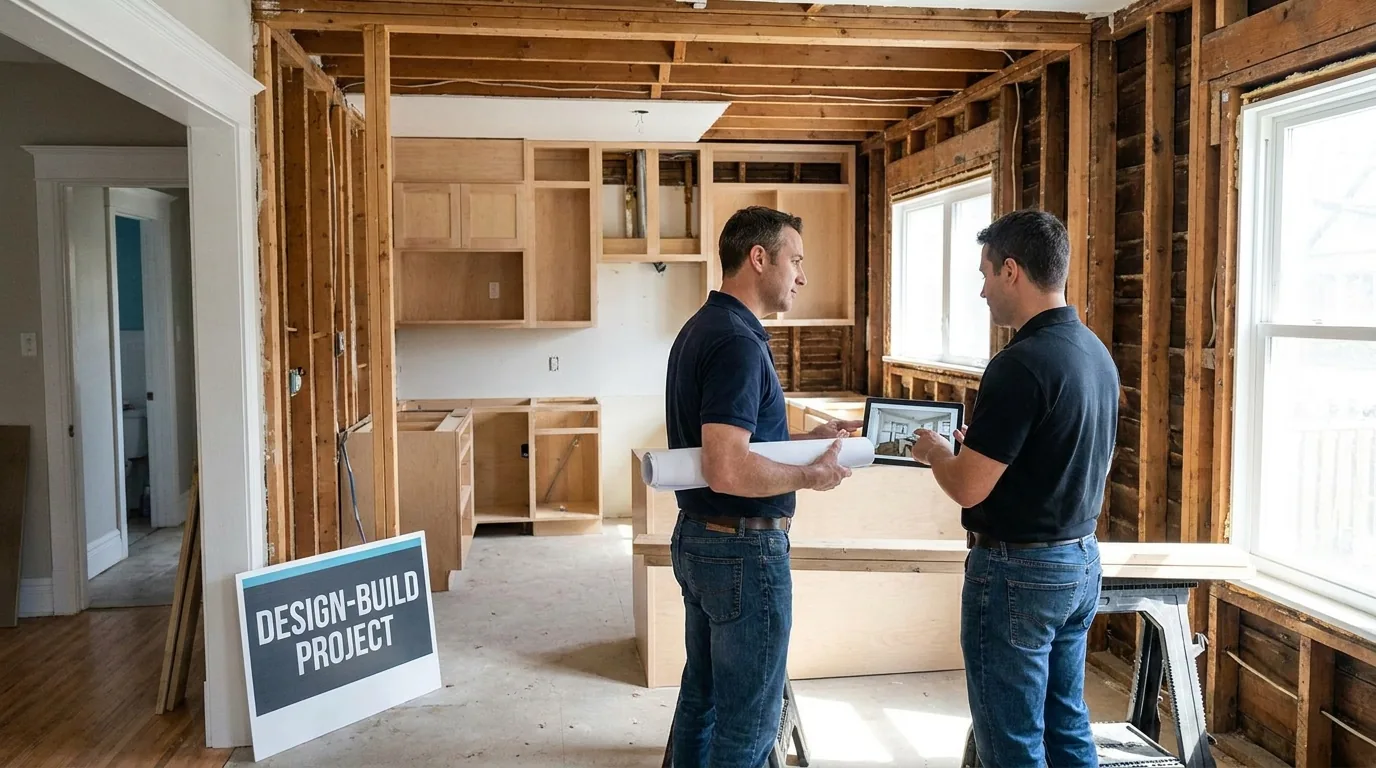
The terms get used loosely. People hear "design-build" and assume it means a contractor who has a designer on staff. That is part of it but not the whole picture.
The real difference between design-build and traditional construction is the contract structure, where accountability sits, and how the design and construction phases overlap. After running both models for two decades, here is how each one actually plays out for an Ottawa homeowner.
Traditional construction: how it works
You hire an architect. They design your project. You sign their fee agreement (typically 8 to 15 percent of construction value). They work with you for 2 to 8 months on schematic design, design development, and construction documents. They produce a permit-ready drawing set.
You then take those drawings to three or four contractors and request bids. The contractors price the drawings, ask questions, and submit fixed-price or cost-plus quotes. You pick a contractor. You sign a separate contract with them. Construction starts.
The architect typically stays involved during construction as your representative, reviewing the contractor's work and certifying payment requests. That is another 2 to 5 percent of project cost.
Total professional fees: 10 to 20 percent of construction value. Total time from first call to construction start: 4 to 12 months.
Design-build: how it works
You call one company. They do an in-home consultation, scope your project, and quote a design fee or roll the design into the construction contract. The same company designs the project, produces the construction documents, pulls the permits, and builds the work.
You sign one contract that covers everything. Sometimes it is two phases (design phase, then construction phase) under one umbrella agreement. Sometimes it is a single fixed-price agreement that covers design and construction together.
Total professional fees: typically 5 to 9 percent of construction value rolled into the contract. Total time from first call to construction start: 6 to 16 weeks.
The five real differences
1. Contract structure and accountability
Traditional: two contracts. Architect is responsible for design quality. Contractor is responsible for construction quality. When something goes wrong (and on every project, something goes wrong) each one points at the other.
Design-build: one contract. One company is responsible for both design and construction. There is nobody to point at. They own the outcome end to end.
The single biggest reason owners hire design-build is to eliminate the architect-versus-contractor finger-pointing. When the same firm draws it and builds it, the buck stops in one place.
2. Cost certainty
Traditional: you do not know the construction cost until the architect's design is done and the contractors bid. About 30 percent of traditional projects come back from bid 15 to 40 percent over the architect's estimate. The owner then has to redesign or fund the gap.
Design-build: pricing happens during design, because the same company that draws it builds it. They cost the design as it develops and tell you what each design choice does to the budget. You arrive at construction with a design you can actually afford.
Across most residential renovation work, design-build can offer fixed-price contracts because they know their own pricing and lead times. Traditional rarely offers fixed-price because the architect has not promised to build it.
3. Speed
Traditional: design phase is sequential. Schematic design, then design development, then construction documents, then bidding, then construction. 4 to 12 months from first sketch to first hammer.
Design-build: design and construction can overlap. Cabinet design can finalize while demo is happening. Tile selection can finalize while drywall is going up. 6 to 16 weeks from first sketch to first hammer for renovation projects.
For a kitchen renovation: traditional path averages 14 to 20 weeks total elapsed time. Design-build averages 12 to 16 weeks total. The compression is real and material.
4. Design ambition and risk
Traditional: architects are advocates for the design. They will push you toward more ambitious solutions, sometimes beyond what your contractor will price reasonably. The result can be extraordinary. The risk is over-design and over-budget.
Design-build: the design team works inside the construction company's pricing. They are biased toward designs the firm can deliver profitably. The result is reliably buildable. The risk is under-ambition.
For most residential renovations (kitchens, bathrooms, basements, additions, coach houses), the design-build trade-off favours the homeowner: reliably buildable for a known price.
For genuinely architecturally ambitious projects (heritage restoration, complex modern, unusual lot conditions), traditional with a strong architect is often the right choice. The extra cost and time buys design freedom.
5. Day-to-day communication
Traditional: you talk to the architect during design. You talk to the contractor during construction. Sometimes you talk to both. The handoff between them is a known weak point. Design intent gets lost in translation.
Design-build: one company throughout. Designer attends construction meetings. Contractor was in the room when the design was finalized. Decisions on site happen with full context.
The pricing-during-design advantage, in detail
In a typical kitchen design with us, we are pricing in real time as the design develops. Cabinet style A vs cabinet style B is a swing we tell you about while you are choosing. Quartz vs natural stone is a decision priced before you commit. Mid-design you know what you are spending. Mid-design in a traditional project you are still guessing.
When design-build is the wrong choice
Three situations where traditional construction with a separate architect makes more sense:
- Heritage restoration on a designated property: Heritage Ottawa, the City Heritage staff, and Ontario Heritage Trust expect drawings from an architect of record with heritage experience. A design-build firm without that specialty cannot manage those approvals reliably
- Genuinely complex architectural ambition: if you want a Pritzker-influenced modern home with curved walls, structural glass, and a cantilever, you need an architect with that practice. Most design-build firms (us included) do not employ that level of architectural design talent
- High-budget custom homes where time is not the constraint: if you have 18 months and the budget to back it, a traditional architect-led process can produce a more refined result than a design-build firm typically targets
When design-build is the right choice
Most residential renovation work fits into design-build naturally:
- Kitchen renovations
- Bathroom renovations
- Basement finishings
- Coach houses and secondary dwellings
- Home additions and second-storey lifts
- Whole-home renovations
- Anything where time-to-completion or cost certainty matters more than maximum design ambition
The hybrid model
For some projects we work as the design-build firm in collaboration with an external architect or interior designer the homeowner brought in. The homeowner has the architect they want for design refinement. We carry the building responsibility, cost certainty, and execution.
This works when the architect is comfortable with collaborative pricing and is not insistent on a traditional bid process. It does not work when the architect refuses to discuss pricing during design and insists on a finished drawing set before any contractor sees it.
What this means for your project
Most Ottawa homeowners renovating a kitchen, bathroom, basement, addition, or coach house should default to design-build. The cost certainty, speed, and single accountability outweigh the design-ceiling reduction in almost every case.
If you are designing a true custom home with significant architectural ambition, a strong architect and traditional contracting can deliver a better outcome.
If you are uncertain, ask both kinds of firms what they would do with your project and what each would cost in fees and time. The answers will tell you which model fits.
Want to see what design-build looks like for your project? See our home renovation service or call 613-862-4555. Free in-home consultation, design fees rolled into the construction quote on most projects.
Frequently asked questions
What is the difference between design-build and traditional construction?
Design-build and traditional construction differ in contract structure and accountability. Traditional construction uses two contracts: an architect designs, then contractors bid on the drawings and a separate contract covers the build. Design-build uses one company, and usually one contract, to design the project, produce construction documents, pull permits and build. With one firm drawing and building, there is no architect-versus-contractor finger-pointing when something goes wrong.
How long before construction starts with design-build versus an architect?
Design-build typically reaches construction in 6 to 16 weeks from the first call, while the traditional architect-led path takes 4 to 12 months, because schematic design, design development, construction documents and bidding run in sequence. For a kitchen renovation, the traditional path averages 14 to 20 weeks of total elapsed time and design-build averages 12 to 16 weeks, since design and construction can overlap.
How do professional fees compare between design-build and traditional?
Professional fees on the traditional path total 10 to 20 percent of construction value: typically 8 to 15 percent for the architect's design, plus 2 to 5 percent for review during construction. Design-build fees typically run 5 to 9 percent of construction value, rolled into the contract. Traditional projects also carry bid risk, since about 30 percent come back 15 to 40 percent over the architect's estimate.
When is a traditional architect a better choice than design-build?
A traditional architect-led process is the better choice in three situations. Heritage restoration on a designated property needs an architect of record with heritage experience for Heritage Ottawa, City Heritage staff and the Ontario Heritage Trust. Genuinely complex architecture, such as curved walls, structural glass or a cantilever, needs an architect with that practice. A high-budget custom home with 18 months to spare can also reach a more refined result.
Can I bring my own architect to a design-build firm?
A design-build firm can work alongside an architect or interior designer the homeowner brings in. The architect handles design refinement while the design-build firm carries building responsibility, cost certainty and execution. This hybrid model works when the architect is comfortable discussing pricing during design. It fails when the architect insists on a finished drawing set and a traditional bid process before any contractor sees the project.
Official references
- Do I need a building permit?, City of Ottawa