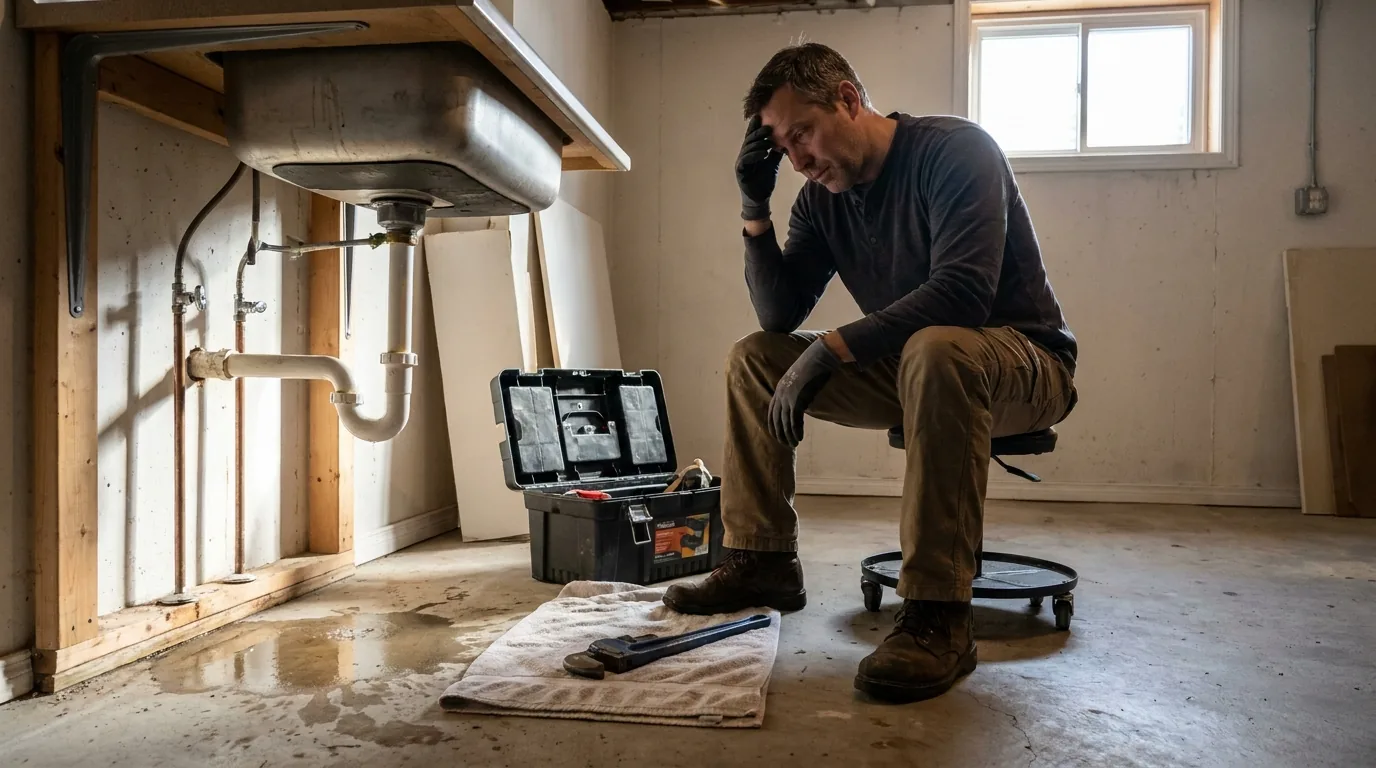
Plumbing is the trade where a small mistake costs nothing for a year and then costs you a torn-out floor in one Saturday morning. The supply side punishes you fast (a leak shows up the same day). The drain side punishes you slow (the floor under the bathroom rots for two years before anybody notices).
I've helped a lot of Ottawa homeowners save money by doing the right plumbing work themselves. I've also been called in to rip out floors and joists because somebody DIY'd a job that should have been left alone. Here is the line.
What you can do yourself, no problem
These jobs are low risk. The shutoff valves are right there. The work is mechanical and reversible. If something is wrong, you find out before you close up the wall.
Faucet replacement
Pulling out a kitchen or bathroom faucet and putting in a new one is a Saturday job. Shut off the supply lines under the sink. Disconnect the supply hoses. Loosen the mounting nut from below. Drop the new one in. Reverse the steps.
The two things that go wrong: rusted shutoffs that won't move (call a plumber to replace the shutoffs first), and over-tightening the supply lines (cracks the threads on the new faucet, you buy another one). Neither is catastrophic.
Toilet replacement, if the floor is solid
A toilet swap is straightforward if the subfloor under the existing toilet is sound. Shut off the supply, flush, sponge out the tank and bowl, disconnect the supply, unbolt from the floor, lift it off. Scrape the old wax ring off the flange. Set a new wax ring (or a Fluidmaster Better Than Wax). Drop the new toilet on, bolt it down evenly, reconnect.
The trap: if the floor under the existing toilet feels soft when you press on it, or the flange is rusted out, or the toilet was rocking before you removed it, stop. The subfloor is rotted and you have a much bigger job.
A pro replacement of a rotted toilet flange and subfloor patch is a far larger scope than the toilet swap itself, driven by how much rotted framing has to come out. Pretending the floor is fine and dropping a new toilet on it just resets the clock on a leak that will eventually drop water through the dining room ceiling.
Replacing supply lines and shutoff valves
Braided stainless supply hoses on a faucet, dishwasher, or toilet are wear items. They have a 5 to 10 year life. Replacing them is two wrenches and a towel. Do it before they fail.
Showerhead, hose bib, garbage disposal swap
All Saturday-level work. The supply is upstream of the work, the connections are accessible, the failure modes are obvious.
The cheap part that prevents the expensive disaster
Every supply line going to a toilet, sink, dishwasher, or washing machine in Ottawa should have an inline shutoff that you can actually reach and that actually works. If yours is seized, replace it before you do anything else under that fixture.
It is a few dollars in parts and 30 minutes of work. The cost of not having a working shutoff when something fails at 2 a.m. is water damage across multiple floors.
What a homeowner should not touch
These are the jobs where the failure mode is hidden, the consequences are structural, or the work is governed by code that requires inspection.
Vent stack relocation
Every plumbing fixture has a vent. The vent is the pipe that lets air in behind the water as it drains, so the trap stays sealed. Without a proper vent, the trap siphons dry, sewer gas comes back into the room, and drains gurgle.
The Ontario Building Code (which incorporates the National Plumbing Code) has detailed rules about vent sizing, vent length, and how far a fixture can be from a vent. Moving a vent stack to the other side of a wall, branching a new fixture into an existing vent, or extending a vent through a roof: all permitted work, all needs to be inspected.
DIY in this zone results in plumbing that smells, gurgles, and slowly siphons traps until the bathroom smells like a sewer in February when you close the windows.
Drain belly fixes
A drain belly is a low spot in a horizontal drain line where waste sits and slowly accumulates. Drains need a 1 in 50 slope (about 2 percent) downhill, continuous, no dips. A belly forms when a horizontal run is supported wrong, or when somebody added a fixture and the new branch hangs lower than the original.
Fixing a belly means cutting the drain line, re-supporting it, and re-pitching it. If it's in a finished ceiling or under a slab, the work is invasive. If it's done wrong, the belly comes back. This is plumber territory, end of story.
Slab penetrations and main stack work
Cutting into the basement slab to relocate a drain, tying a new bathroom into the main stack, replacing a section of the cast iron stack: all of these are permit-required, inspector-required, and not a DIY job. The Ontario Building Code requires a building permit for any plumbing rough-in.
Anything that involves a soldered or PEX-press connection in a wall cavity
If the connection is going to be hidden behind drywall and the joint fails, you find out when you see the water stain on the ceiling below. By then there is mould in the cavity. We rip out 8 feet of wall to find a 1-inch fitting that wasn't crimped properly.
The slope mistake that costs you a torn-out floor two years later
Here is the specific story I see over and over. A homeowner adds a basement bathroom themselves. They core through the slab, run a new branch drain to the existing stack, and pour the slab back. Looks great.
What they got wrong: the slope on the new branch is 1 in 100 instead of 1 in 50. Half the required pitch. The drain works fine for the first six months because gravity still pulls water through. Slowly, solids accumulate. The branch starts backing up. The homeowner snakes it. It clears. Six months later, it backs up again.
By year two, the only fix is jackhammering the new bathroom floor, removing the branch drain, re-pitching it, and pouring the slab back. With finishes, that rework costs several times what the proper rough-in would have, because you are now paying to demolish and rebuild a finished floor. All of it to skip getting the slope right the first time.
Plumbing rough-in errors are invisible the day they happen. They show up on the schedule of the failure, not the schedule of the install.
The permit question
People ask if you really need a permit for plumbing work in Ottawa. The Ontario Building Code answer is yes for any rough-in, any new fixture, any drain or vent modification. Same-fixture replacement (toilet for toilet, faucet for faucet) is exempt. Adding a basement bathroom, moving a kitchen sink across the room, adding a second-floor laundry: all permitted work.
The City of Ottawa permit minimum is $117. The plumbing permit fee on a basement bathroom is set by the City and scales with the scope of the rough-in. The inspection is included. Skip it and the next buyer's lawyer asks for documentation you do not have, the deal closes weeks late, and the seller credits the buyer to make the problem go away.
What we tell Ottawa homeowners
The line is honest: anything downstream of a working shutoff valve, you can probably handle. Anything upstream, anything in the wall, anything involving slope, vents, or the main stack, leave it to a licensed plumber.
Most of our bathroom renovation jobs include the plumbing rough-in as a line item. The cost is real but it is one of the smallest line items in a full bathroom renovation, and it is the part that protects every other dollar in the project. The fixtures last 20 years. The rough-in lasts the life of the house, if it was done right.
The wrench down rule: if you cannot see the connection from the room you are standing in, do not be the one putting it together.
Frequently asked questions
What plumbing jobs can a homeowner safely do themselves?
Jobs downstream of a working shutoff valve are generally safe for a homeowner: faucet replacement, a toilet swap on a solid floor, braided supply lines and shutoff valves, a showerhead, a hose bib or a garbage disposal.
The supply is upstream of the work, connections are accessible and failures show up before a wall closes. Anything in the wall, anything involving slope, vents or the main stack belongs to a licensed plumber.
How often should braided supply lines be replaced?
Braided stainless supply hoses on a faucet, dishwasher or toilet are wear items with a 5 to 10 year life. Replacing them takes two wrenches and a towel, and the job should be done before they fail. Every supply line to a toilet, sink, dishwasher or washing machine should also have a reachable inline shutoff that actually works; a seized shutoff should be replaced first, which takes about 30 minutes.
When should I stop a toilet replacement and call a plumber?
Stop if the floor around the old toilet feels soft when pressed, if the flange is rusted out, or if the toilet rocked before removal. Any of those signs means the subfloor has likely rotted and the job is much bigger than a toilet swap. Setting a new toilet on a rotted floor only resets the clock on a leak that can eventually come through the ceiling below.
What slope does a drain line need?
A horizontal drain needs a continuous downhill slope of 1 in 50, about 2 percent, with no dips. A low spot, called a belly, collects waste and slowly clogs the line.
A common DIY basement bathroom mistake is a branch drain at 1 in 100, half the required pitch: the drain works for months, then keeps backing up, and by year two the fix means jackhammering the finished floor to re-pitch the pipe.
Do I need a permit for plumbing work in Ottawa?
Yes for any rough-in, any new fixture, and any drain or vent modification, under the Ontario Building Code. Replacing a fixture with the same type, toilet for toilet or faucet for faucet, is exempt. Adding a basement bathroom, moving a kitchen sink across the room or adding a second-floor laundry are all permitted work. The City of Ottawa permit minimum is $117, and the inspection is included.