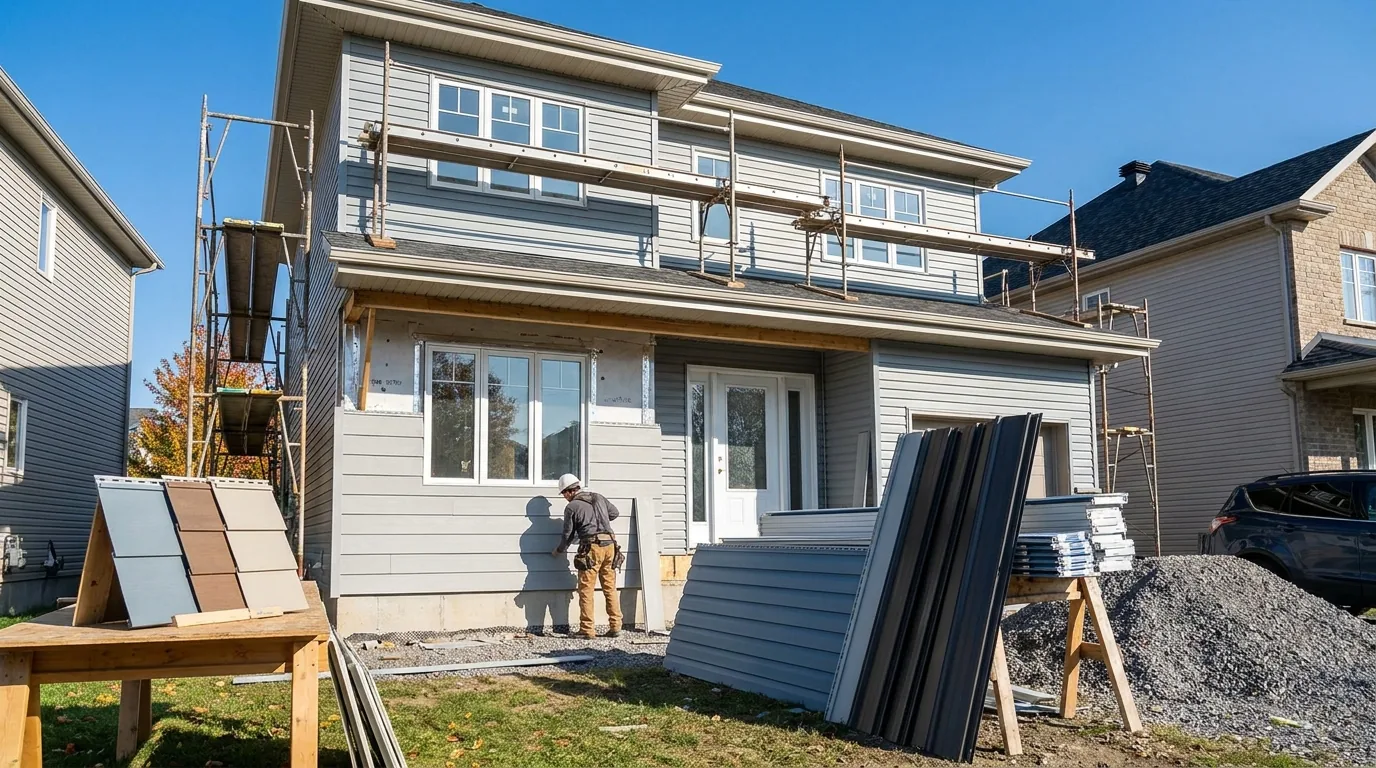
Siding is the most visible exterior renovation a homeowner makes, and it is the one where wall area drives the budget hardest because we are talking about 1,800 to 3,200 sq ft of wall surface on a typical Ottawa house. Whatever the per-square-foot rate of the material you choose, it compounds quickly across that much area.
Below is what actually drives siding pricing in Ottawa by material, how a whole-house re-side quote is built, and why James Hardie has become the default choice for renovators who plan to stay 15-plus years.
What "installed" pricing covers
When we price siding "installed," the scope means: tear-off of existing siding, repair or replacement of housewrap (Tyvek or equivalent), new siding material, trim, J-channel at openings, soffit and fascia replacement if scoped, and disposal of old material. It does not include exterior insulation (scoped separately) or window or door replacement. Every quote we issue itemizes these lines so you can see exactly what is in and what is out.
Materials ranked by relative cost
Materials sit on a clear ladder, lowest installed cost to highest. The order matters more than any single figure, because it holds steady even as material markets move:
- Vinyl, builder-grade: the entry point. Lowest material and labour cost.
- Vinyl, premium thicker grade (Mitten Sentry, CertainTeed Monogram): a step up for thickness and colour stability.
- Engineered wood (LP SmartSide): mid-tier, real-wood look at a workable rate.
- James Hardie fiber cement, primed: upper-mid, painted on site after install.
- James Hardie fiber cement, ColorPlus pre-finished: premium fiber cement, factory finish.
- Metal cladding (steel or aluminum panel): premium tier, longest service life.
- Cedar shingle, primed and painted: premium, often required on heritage homes.
- Stone or brick veneer accent: the highest per-square-foot line, usually used as an accent rather than full coverage.
How a whole-house siding quote is built
A 2,000 sq ft footprint Ottawa two-storey has roughly 2,400 to 2,800 sq ft of exterior wall (excluding windows and doors). The whole-house number is that wall area multiplied by the installed material rate, plus trim, soffit, fascia, and any remediation. The result is that two homes of the same footprint can land far apart depending on the cladding chosen and the trim complexity.
The headline figure depends entirely on the material tier. Within the same material, the spread is mostly trim complexity: dormers, gables, multiple stories, and architectural details add labour without adding much siding area. We give you a fixed written proposal so the number is settled before any tear-off begins.
Why James Hardie ages well in Ottawa
Ottawa is hard on exterior cladding. Sub-zero winters, freeze-thaw, summer humidity, UV from snow reflection, and salt spray on streetside walls. Each material handles these stresses differently.
Vinyl: shrinks and expands with temperature. The thinner builder-grade vinyl gets brittle below minus 20 Celsius and is prone to cracking when impacted. Color fades on south and west exposures within 8 to 15 years. Sun-faded vinyl cannot be repainted (paint will not adhere properly long-term).
James Hardie fiber cement: dimensionally stable across temperature swings. Does not crack from cold impact (we have hit Hardie boards with hammers; they dent before they crack). Holds paint for 15 to 20 years on the ColorPlus pre-finish. Repaintable when the original finish reaches end of life. Fire-rated.
Engineered wood (LP SmartSide): good middle ground. Looks like real wood lap siding. Less expensive than Hardie. Holds paint reasonably well, but not as long as Hardie ColorPlus. Can swell at cut edges if not sealed properly during install.
Metal: the most durable and the most expensive. Will outlast every other material on this list. Aluminum dents easily in hailstorms (Ottawa gets a few real hail events per decade). Steel resists denting better. Both hold their finish for 30-plus years.
Hardie at 25 years still looks like new. Vinyl at 25 years has faded, brittled, and probably needs replacement. The price difference is real, and so is the lifespan difference.
Insulation behind siding: a worthwhile adder
Adding rigid foam insulation behind new siding is the single most cost-effective energy retrofit available to an Ottawa homeowner doing a full re-side. The siding has to come off anyway. Adding 1.5 to 2 inches of rigid foam to the wall while the cladding is off is a modest per-square-foot adder on top of the siding rate, and we price it as a separate, optional line.
What this gets you: roughly R-7 to R-10 of additional thermal value over your existing wall assembly. On a 2,400 sq ft Ottawa house, this measurably reduces annual heating bills and significantly improves comfort on north-facing exterior walls.
The catch: the wall thickness grows by 1.5 to 2 inches, which means windows have to be either pulled and re-installed flush with the new exterior surface (more labour per window) or extended outward with new sill and head pieces (less invasive, but the windows look recessed compared to where they were). We flag this trade-off in the proposal so you decide with full information.
For Ottawa homeowners doing a full re-side on a pre-1980 home, exterior insulation pays off in roughly 8 to 12 years. The decision is straightforward.
The 25-year lifespan comparison
Builder vinyl: lower up-front install, but faded and brittle by year 18 to 22, so it typically needs full replacement around year 22 — meaning you pay for the install twice inside 25 years. James Hardie ColorPlus: higher up-front install, one repaint around year 18 to 22, and still original boards at year 25.
Over the full horizon, the gap between the two narrows sharply once you account for the second vinyl install. That lifecycle math, not the sticker, is what should drive the material decision.
Trim, fascia, and soffit: where quotes diverge
The siding itself is one line item. Trim, soffit, fascia, eavestrough, and downspouts are separate, and they often add up to 25 to 40 percent of the total exterior package. Watch quotes that are quote the siding cheaply but bury other items in scope.
- Aluminum soffit and fascia: priced per lineal foot installed; the lowest-cost trim line.
- Aluminum eavestrough, 5 inch K-style: standard residential gutter.
- Aluminum eavestrough, 6 inch (recommended for Ottawa snow loads): a step up for capacity in heavy snowmelt.
- Vinyl exterior trim around windows and corners: the budget trim option.
- Hardie trim around windows and corners: matched to fiber-cement siding, mid-tier.
- Composite or PVC trim: the premium, rot-proof trim line.
For a typical Ottawa two-storey home, plan on 220 to 300 lineal feet of trim and 110 to 160 lineal feet of soffit and fascia. That trim package is a meaningful line item on top of the siding, and we itemize it separately so it never gets buried.
What pushes Ottawa siding costs up
Three Ottawa-specific factors push siding budgets up that quotes do not always anticipate.
Two-storey access. Anything above 12 feet requires scaffolding or a lift, which adds rental and setup labour. Scaffold setup and tear-down is half a day on each end. Three-storey homes (Centretown, Hintonburg) cost roughly 15 to 25 percent more per sq ft than equivalent bungalows because of access alone.
Heritage districts. Glebe, Sandy Hill, parts of Westboro, and Centretown have heritage zoning that can require specific siding profiles, materials, or paint colors. Cedar shingle replacement on a heritage home sits at the premium end of the material ladder and may require multiple permit reviews, which add design and approval time to the scope.
Bug and rot remediation behind existing siding. When old siding comes off, rotted sheathing, carpenter ant damage, and failed flashing details get exposed. This is when scope expands. We build a contingency allowance into the proposal for behind-the-siding repair. We see this on roughly half of Ottawa re-side jobs over 25 years old.
Real example: 1989 Kanata two-storey, 2025
2,650 sq ft of exterior wall, original aluminum siding from 1989, tearing off to install Hardie ColorPlus in graphite gray with white trim.
The fixed-price proposal itemized every line: tear-off and disposal, housewrap (Tyvek HomeWrap) replacement, Hardie installation across the full wall area, Hardie trim around 14 windows and corners, new aluminum soffit and 6-inch eavestrough, and two stretches of rotted sheathing repair found behind the old siding (26 sq ft total). The owner saw each line broken out before work started, so there were no surprises.
For full exterior renovation including siding, windows, and roof together, see our whole-home renovation page.
Bottom line: vinyl wins on up-front cost, James Hardie ColorPlus wins on lifespan. If you plan to be in the home 15-plus years, Hardie is the right financial decision. Add exterior insulation if you are already doing a full re-side; the payback is fast in this climate. Call 613-862-4555 for a fixed-price siding quote with a detailed written breakdown.
Frequently asked questions
How long does vinyl siding last in Ottawa?
Builder-grade vinyl siding in Ottawa is typically faded and brittle by year 18 to 22 and needs full replacement around year 22. Thin vinyl gets brittle below minus 20 Celsius and can crack on impact, and colour fades on south and west walls within 8 to 15 years. Sun-faded vinyl cannot be repainted, because paint will not adhere properly long-term.
How does James Hardie fiber cement siding hold up in Ottawa?
James Hardie fiber cement stays dimensionally stable through Ottawa temperature swings and does not crack from cold impact; the boards dent before they crack. The ColorPlus pre-finish holds paint for 15 to 20 years, and the boards can be repainted when that finish wears out. Fiber cement is also fire-rated. At 25 years, Hardie ColorPlus typically needs one repaint while keeping the original boards.
Should I add rigid foam insulation when replacing siding?
Adding 1.5 to 2 inches of rigid foam behind new siding gives roughly R-7 to R-10 of extra thermal value, and the siding has to come off anyway. On a pre-1980 Ottawa home, exterior insulation pays off in roughly 8 to 12 years. The catch is that walls grow 1.5 to 2 inches thicker, so windows must be reset flush or extended with new sills and heads.
What does an installed siding quote include?
An installed siding quote normally covers tear-off of the old siding, repair or replacement of the housewrap, the new siding, trim, J-channel at openings, soffit and fascia if scoped, and disposal. Exterior insulation and window or door replacement are separate. Trim, soffit, fascia, eavestroughs and downspouts often add 25 to 40 percent of the total exterior package, so check they are itemized.
What problems turn up when old siding comes off?
Removing old siding often exposes rotted sheathing, carpenter ant damage and failed flashing details, and that is where scope expands. The problem shows up on roughly half of Ottawa re-side jobs on siding over 25 years old, so a contingency allowance for behind-the-siding repair belongs in the proposal. On one 1989 Kanata two-storey, 26 sq ft of rotted sheathing turned up behind the aluminum.
Official references
- Keeping the Heat In, Natural Resources Canada
- Do I need a building permit?, City of Ottawa